













7 Animals That Wore Backpacks for Science

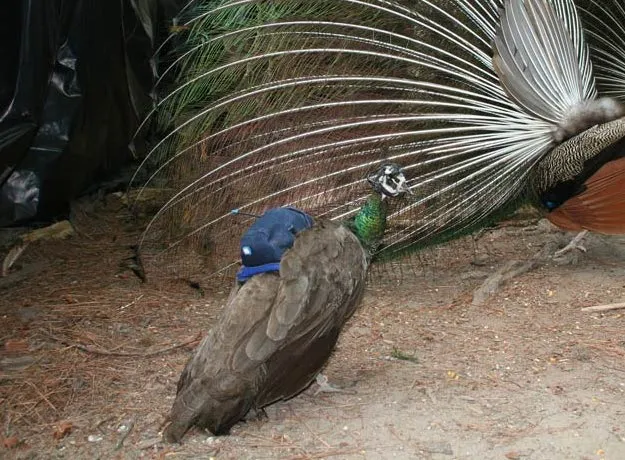
From falcons to cockroaches, a myriad of different animals have donned backpacks in the name of science.
These backpacks typically carry cameras, GPS or other sensors, and can tell scientists a great deal about the animals' movements, feeding habits and interactions with others, while also offering a creature's-eye view of the world.
Here, we bring you a few of these rucksack-sporting critters.
Falcons

To get a glimpse of how falcons hunt their prey midair, researchers at Haverford College in Haverford, Pennsylvania, outfitted the birds with miniature helmet- and backpack-mounted cameras. These resembled tiny versions of "GoPro" cameras that many human athletes wear. The videos showed that falcons fly in such a way that their prey remains motionless in the raptors' sight, which helps the predatory birds intercept their victims. [Beastly Academy Awards: Stars of the Animal Kingdom]
Cockroaches
When you see a cockroach crawling toward you, have you ever wished you could just steer it away like a remote-controlled car? A group of researchers from North Carolina State University in Raleigh made this possible, by implanting electrodes in the body of a Madagascar hissing cockroach. They then attached a tiny backpack containing a wireless receiver, transmitter and microcontroller to the insect's back, using the equipment to control the roach's movement.
Get the world’s most fascinating discoveries delivered straight to your inbox.

Sheep
Sheep usually just follow the pack, but in this case, it seems the (back)pack followed the sheep. A group of researchers at Swansea University, in the United Kingdom, fitted sheep with backpacks containing GPS devices, to develop a model for how a single sheepdog can shepherd a flock of more than 100 sheep, BBC News reported. The model could be used to make "shepherd robots" for crowd control or oil spill cleanup, the researchers said.
Peacocks
With their stunning plumage, peacocks already have a knack for style. But researchers at the University of California, Davis, and Duke University wanted to know what parts of the flashy males' display catch a female's, or peahen's, eye. The team trained captive peahens to wear special backpacks that held equipment, and a helmet with cameras (one to film what the bird was seeing, and one to film the animal's eye movement). It turns out the peacock gals were mostly looking at the lower part of their suitor's feathers, and rarely looked at his head.
Songbirds
Even songbirds have sported tiny backpacks for research purposes. Scientists at York University in Toronto used the packs to track wood thrushes and purple martins during the birds' migration from Pennsylvania to Central and South America. The scientists found that the birds actually traveled three times faster than expected — more than 311 miles (500 kilometers) per day, the researchers said.
Leatherback turtles
If any animal seems built for wearing a backpack, it's a turtle. Researchers at the University of Maryland Center for Environmental Science outfitted some leatherback turtles with backpacks that contained satellite-tracking devices. The researchers monitored the animals near Costa Rica, Mexico, Indonesia and off the California coast, and identified "danger zones" where extensive fishing may harm the turtles, according to Discovery.com.
Dragonflies
In a laboratory in Ashburn, Virginia, researchers are studying dragonflies by strapping tiny backpacks to the insects. The diminutive luggage records the signals from an insect's nerve cells while it's chasing after its prey. The backpacks, though, don't have straps — they're actually glued onto the dragonfly's shoulders, and contain a tiny wire that plugs into the neurons of the insect's spinal cord. The packs broadcast the nerve signals to a computer where the scientists can study them.
Follow Tanya Lewis on Twitter and Google+. Follow us @livescience, Facebook & Google+. Original article on Live Science.
