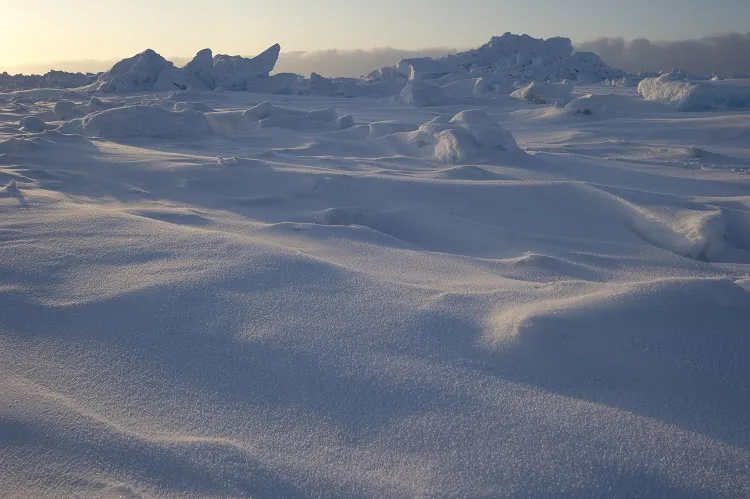
Spring snow in the western Arctic has thinned by about a third and, in some regions, is less than half as thick as it was in the 1950s, decades of research has revealed.
A team of researchers analyzed data from NASA's IceBridge air surveys from 2009 to 2013, data from U.S. Army Corps of Engineers'buoys that were frozen into ice sheets and historic data collected by Russian scientists from 1954 to 1991. The results show that snow depth has thinned from 14 inches to 9 inches (36 centimeters to 23 centimeters) in the western Arcticand from 13 inches to 6 inches (33 cm to 15 cm) over the Beaufort and Chukchi seas, west and north of Alaska, respectively.
"Knowing exactly the error between the airborne and the ground measurements, we're able to say with confidence, yes, the snow is decreasing in the Beaufort and Chukchi seas," Ignatius Rigor, an oceanographer at the University of Washington's Applied Physics Laboratory in Seattle, said in a statement. [On Ice: Stunning Images of Canadian Arctic]
The scientists said that the data confirm earlier research and demonstrate that Arctic snow is continuing to thin. Arctic snow cover that accumulates atop sea ice may be diminishing because the seas are freezing over later in the fall each year, the researchers said. The heaviest Arctic snowfalls in September and October now come before the ice forms, meaning the snow mostly falls into open water, they noted.
It's still unclear to researchers what thinner snow will mean for the Arctic. Thick snowpack acts like a blanket and shields ice from the cold Arctic air. A thinner layer of snow could allow ice sheets to thicken more during the winter months, but less snow could also mean that the ice melts earlier and faster during the spring.
The thinning snowpack could also influence the Arctic ecosystem, the researchers said. Tiny microscopic plants that form the backbone of the Arctic food chain grow under sea ice. Arctic animals also rely on snowpack to build dens.
Melinda Webster, a graduate student at the University of Washington, uses a probe to measure the Arctic snow thickness near Barrow, Alaska in 2012.
(Image credit: Chris Linder/University of Washington)
Researchers say it is important to continue monitoring snow and ice levels at the Earth's poles. In the past, Russian scientists measured snow depth with meter sticks and kept handwritten records each year. Now, measuring techniques are more sophisticated, and scientists can use a probe (roughly the size and shape of a ski pole) to quickly measure snowpack thickness. After stabbing the pole through the snow, a basket at the end of the pole slides up and records the distance between the basket and the end of the pole.
Sign up for the Live Science daily newsletter now
Get the world’s most fascinating discoveries delivered straight to your inbox.
Melinda Webster, a graduate student at the University of Washington, used these probes to verify the accuracy of the data collected by NASA flyovers. In 2012, she retraced the path of a NASA flight, sticking the probe into the snow every few steps. NASA is planning to launch a new ice-sheet-monitoring satellite in 2017, called ICESat-2, that will use beams of light particles to measure ice levels.
The new study will be published in the Journal of Geophysical Research: Oceans.
Kelly Dickerson is a staff writer for Live Science and Space.com. She regularly writes about physics, astronomy and environmental issues, as well as general science topics. Kelly is working on a Master of Arts degree at the City University of New York Graduate School of Journalism, and has a Bachelor of Science degree and Bachelor of Arts degree from Berry College. Kelly was a competitive swimmer for 13 years, and dabbles in skimboarding and long-distance running.