













Ancient Amphibians Left Full-Body Imprints

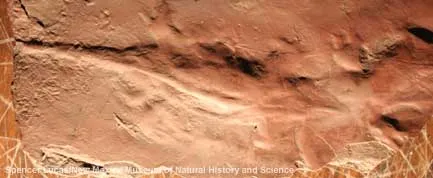
Exquisitely preserved fossilized body imprints of ancient salamander-like creatures have been discovered in 330-million-year-old Pennsylvanian rocks.
The foot-long amphibians lived 100 million years before the first dinosaurs. "Body impressions like this are wholly unheard of," said paleontologist Spencer Lucas, a curator at the New Mexico Museum of Natural History.
Lucas planned to present the discovery Tuesday at the annual meeting of the Geological Society of America in Denver.
While lacking bones, the body imprints contain other rare information about the bones, Lucas said. Without the imprints of the webbed four-toed feet, for instance, it would be virtually impossible to say they were truly amphibians. The imprints also provide body proportions data and reveals the creatures' skin was smooth, not armor plated as might be expected, Lucas said.
The imprints were found in reddish- brown, fine-grained sandstone of the Mauch Chunk Formation in eastern Pennsylvania. The rocks were collected decades ago but had been sitting, unexamined, in the Reading Public Museum Collection in that state. They were rediscovered by college student David Fillmore as part of his senior thesis at Kutztown State University, also in Pennsylvania
- A Brief History of Dinosaurs
- Many Amphibians Threatened Worldwide
- Image Gallery: New Amphibian Tree of Life
Get the world’s most fascinating discoveries delivered straight to your inbox.
