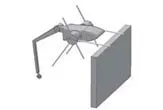
The IMPASS robot will use rimless wheels with spokes that can lengthen or shorten according to terrain. IMPASS, which stands for Intelligent Mobility Platform with Active Spoke System, is under development at Virginia Polytechnic Institute and State University.
According to one of the developers, engineer Dennis Hong, the spoke wheel concept "allows multiple modes of motion, which give it the ability to stride quickly using one contact point per wheel, walk with static stability with two contact points per wheel, or assume a stable stance using three contact points per wheel."
Hong designed the system along with colleague Doug Laney.
Legs work better when negotiating very rough terrain, but are often slower than wheeled vehicles on smooth surfaces. The IMPASS system tries for the best of both worlds; the three spokes can be made to lengthen or shorten independently, allowing the robot to adjust itself to overcome obstructions. Turning can be done by varying spoke length as well.
Science fiction writer NealStephenson, in his 1992 novel SnowCrash, writes about this very same idea - he calls them smartwheels and puts them on skateboards:
Smart wheels use sonar, laser range finding and millimeter wave radar to identify mufflers and other debris. Each one consists of a hub with many tiny spokes. Each spoke telescopes into five sections. On the end is a squat foot, rubber tread on the bottom, swiveling on a ball joint. As the wheel rolls, the feet plant themselves one at a time, almost glomming into one continuous tire...
(Read more about Neal Stephenson's smart wheels)
Hong and Laney hope to complete a prototype version of the IMPASS robot early next year.
Sign up for the Live Science daily newsletter now
Get the world’s most fascinating discoveries delivered straight to your inbox.
You might also be interested in this related item - the Tweel,which combines both the spokes and the tire. Here's another device that actuallymoves by adjusting spoke length - SoftRobot Powered by Shape Memory Alloy Spokes. The original story was found here.
Bill Christensen catalogues the inventions, technology and ideas of science fiction writers at his website, Technovelgy. He is a contributor to Live Science.