













Doggy Kisses: Oxytocin May Make Fido More Affectionate
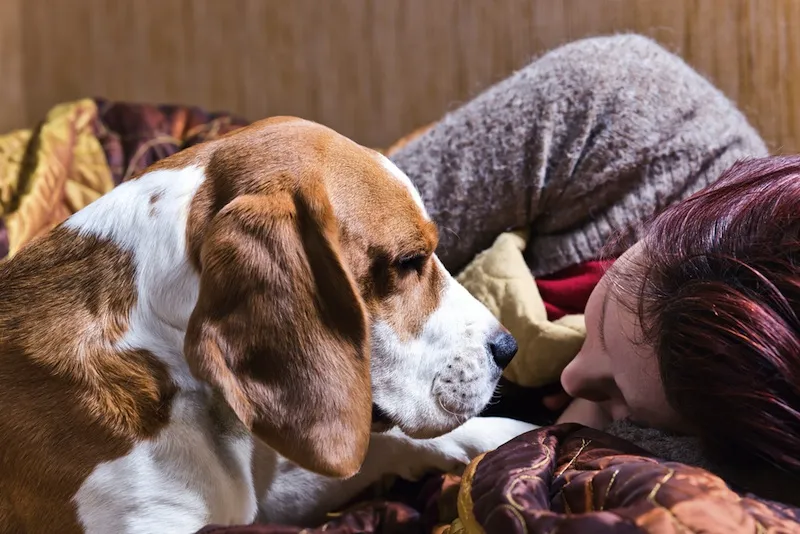
Oxytocin — a chemical commonly known as the "love hormone" — might help strengthen the bond between man and his best friend.
When scientists in Japan gave dogs a quick whiff of an oxytocin nasal spray, the pooches became more affectionate toward their owners.
In humans, oxytocin is naturally released from the pituitary gland — a tiny globe at the base of the brain — during special moments like snuggling, orgasms, childbirth or breastfeeding. Though the hormone is often associated with the connection between lovers and the chemical bonds between mothers and their children, the new findings suggest oxytocin might also help maintain nonromantic social relationships between different species. [11 Interesting Effects of Oxytocin]
In the study, researchers analyzed the interaction between 16 dogs and their owners both before and after they gave the dogs a nasal spray of oxytocin. After observing the dogs' behavior in regular conditions for half an hour, the researchers separated the dogs from their owners. Then they administered a spritz of either oxytocin or saline (used as a control) through the dog's nostril.
Unaware of which type of spray their pet received, the owners met their dogs again and were told to ignore any affectionate advances so that the effects of oxytocin would be clear.
The dogs that received oxytocin sniffed, licked and pawed at their owners more affectionately than before, while the dogs given the simple saline behaved normally. The dogs that got a hit of oxytocin also spent more time sitting closeby and staring into their owners' eyes — a friendly behavior that the American Society for the Prevention of Cruelty to Animals (ASPCA) recognizes as a sign that the dog hopes to be noticed.
Though the hormone's exact mechanism in dogs is unclear, the researchers speculate that the spray increased the animals' heart rate as it traveled to the brain and prompted a further, natural secretion of oxytocin.
Get the world’s most fascinating discoveries delivered straight to your inbox.
"Studies in humans have already shown that oxytocin affects our tendency to affiliate or cooperate with other people," veterinarian Miho Nagasawa at Japan's Azabu University told Discovery News. "We believe that oxytocin is a hormonal mechanism that facilitates the maintenance of close social bonds not only in dogs or cats, but also in any mammal species, since the oxytocin system is very ancient and has similar functions in a wide number of taxa."
The study supports previous research suggesting oxytocin might explain the inseparable bond between dogs and their owners. In a 2009 study, researchers found that when owners played with their dogs, the owners experienced a natural surge of oxytocin.
Nasal sprays of oxytocin can have a warm-and-fuzzy effect in humans, too. In a study reported in 2012, researchers observed that fathers who received a boost of oxytocin through the nose spent more time playing with their 5-month-old babies compared with fathers who didn't get the spritz. In another study out last year in the Proceedings of the National Academy of Sciences, children with autism were given a dose of oxytocin, which caused certain areas of their brain linked to social interaction to become more active.
But oxytocin isn't always the pro-social "love" potion it may appear to be. Past research has shown that high levels of the hormone can also make people exclude or reject others they view as outsiders, or not part of their "in crowd." Whether or not this occurs in dogs — or perhaps between dogs and cats — has yet to be tested.
The new study was published June 9 in the Proceedings of the National Academy of Sciences.
Jillian Rose Lim on Twitter & Google+. Follow us @livescience, Facebook & Google+. Original article on Live Science.