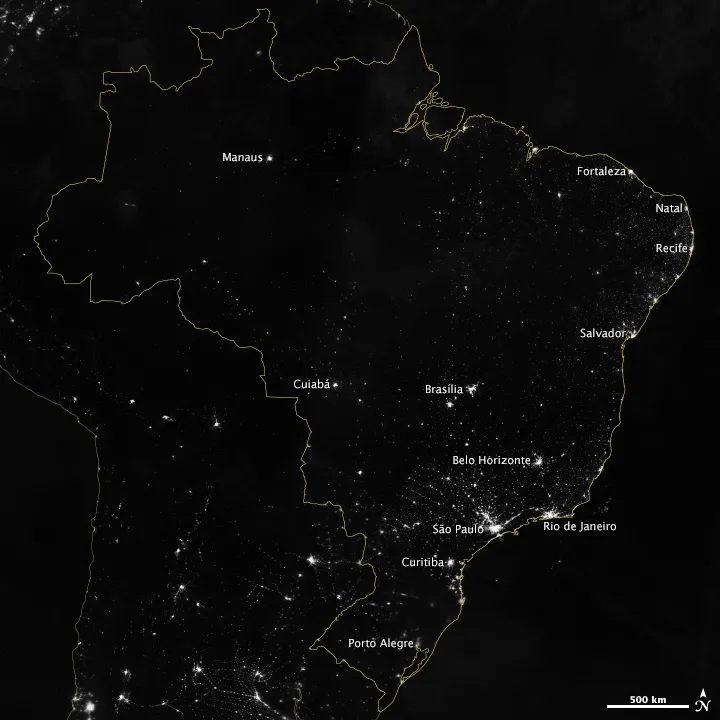
The 20th World Cup kicked off yesterday (June 12) in Sao Paulo, Brazil, and a satellite image captured a stunning nighttime view of the host country.
The two most densely populated cities in Brazil, Sao Paulo and Rio de Janeiro, light up two satellite images taken on Aug. 4, 2013, and released today (June 13) by NASA's Earth Observatory.
Brazil is home to about 200 million people. It stretches about 2,485 miles (4,000 square kilometers) from coast to coast, and covers an area of about 3.3 million square miles (8.5 million square km), making it the fifth-largest country in the world in terms of area. An estimated 600,000 travelers will flock to the country to watch the World Cup games. [Stunning Soccer: The World Cup 2014 from Space (Photos)]
A satellite image shows Rio de Janeiro and Sao Paulo at night.
(Image credit: NASA Earth Observatory)
Like the Olympics, the World Cup is held every four years. This is the first time since 1950 that Brazil has hosted the games. Thirty-two teams will compete for a spot in the final game, to be held in Rio de Janeiro. The Brazilian team has made it to the final match seven times, and won five of them; even so, the team has not won a World Cup since 2002.
The newly released image was captured using the Visible Infrared Imaging Radiometer Suite (VIIRS) on the Suomi NPP satellite. The satellite instrument uses a "day-night band" that can detect a wide range of wavelengths of light. In fact, VIIRS can pick up dim light 100,000 times fainter than regular visible light detectors, making it possible to capture moonlight, nighttime city lights and even layers of clouds.
Unlike a regular camera, VIIRS captures images by scanning an area several times and then translating it into millions of pixels. The "day-night band" analyzes each pixel and determines whether low, medium or high exposure is needed. If a pixel is particularly bright, the satellite will use a low-exposure mode so the image does not look saturated. If a pixel is faint, the satellite uses high exposure to brighten it.
Kelly Dickerson is a staff writer for Live Science and Space.com. She regularly writes about physics, astronomy and environmental issues, as well as general science topics. Kelly is working on a Master of Arts degree at the City University of New York Graduate School of Journalism, and has a Bachelor of Science degree and Bachelor of Arts degree from Berry College. Kelly was a competitive swimmer for 13 years, and dabbles in skimboarding and long-distance running.