













Keeping Time: Time Zones, Trains and the 24-Hour Day
The world goes around and around; morning becomes noon becomes night, and the cycle begins anew. We call one complete rotation of the Earth on its axis a "day." And, we divide each day into 24 units called "hours."
Have you ever wondered, "Why are there 24 hours in a day?" The tradition goes back thousands of years, and it began with the Egyptians. Their practices continue to influence clock design and train schedules.
Ancient calendars and clock systems
One of the most important numbers to ancient astronomers was 12. For one thing, 12 was the number of moon cycles in a year. For another, it was how the Egyptians divided up the sky. The Egyptians divided the sky into sections corresponding to the rise of 36 particular stars. The rising and setting of these stars was a way to tell time during the night. Thus, sunset to sunrise was marked by 18 stars; three of these stars were assigned to each twilight period, so darkness was divided by the remaining 12. During the New Kingdom (16th-11th centuries B.C.), the system was simplified to 24 stars, giving 12 hours to night and an equal number to daylight.
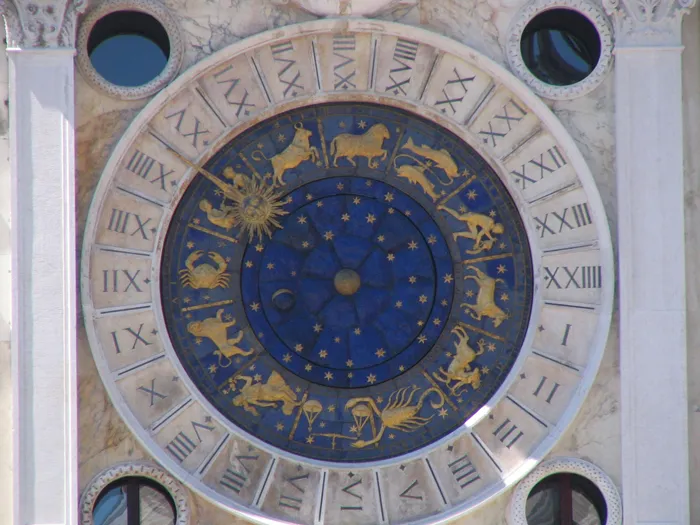
This tradition of dividing the sky into sections associated with certain stars became known as the Zodiac, and it is the basis for calendars of many civilizations from all over the world. While Egypt's Middle Kingdom chose 36 (and later 24) divisions, China chose 12 divisions, and Sumer and India both chose 24.
Keeping time in Ancient Rome
At Rome’s founding in 753 B.C., time of day consisted of only noon, sunset, midnight and sunrise, writes Jérôme Carcopino in his book, “Daily Life in Ancient Rome” (Yale University Press, 1968; edited by Henry Rowell). By the Pyrrhic War (280–275 B.C.), daytime was split into morning, forenoon, afternoon and evening. During the First Punic war (264–241 B.C.) the Greek sun clock — the bottom half of a vertical bowl with 12 markings around a stick — was introduced to Rome, but it would be another century before Roman scholars realized that the markings had to be re-drawn when such a clock was moved to a different latitude.
About this time, Roman censors (officials responsible for maintaining the census) began supplementing shadow clocks with water clocks so time could be determined at night and on cloudy days. To this day, clock hands revolve "clockwise" because this is the direction a sundial’s shadow progresses in the Northern Hemisphere. Since the Roman hour was a twelfth of a day’s sunlight, it varied from 45 to 75 modern minutes, depending on the season. Some water clocks had clever ways around this, such as an hour marker that changed with the months.
From flowing water to ticks and tocks
Water clocks were the standard for timekeeping until well after the fall of Western Rome in the fifth century A.D. According to David S. Landes, in “Revolution in Time” (Belknap, 1983), when Harun al-Rashid, a legendary caliph of Baghdad, wanted to impress Charlemagne he sent him one such “highly animated water clock that told the hours by sound and spectacle.” Mechanical clocks first appeared in Europe in the 14th century and completed one revolution per day, thus showing all 24 hours on the clock face. This was influenced by astronomers' familiarity with the astrolabe and sundial, and their desire to model the apparent motion of the sun. Particularly in Italy, numbering usually read from I to XXIV, ending and starting at sunset.
Get the world’s most fascinating discoveries delivered straight to your inbox.
A.M. and P.M.
Northern European clock faces generally favored a 12-hour numbering scheme, but showed both a.m., a Latin abbreviation meaning “ante meridiem” or "before midday", and p.m. — “post meridiem” or "after midday." Midnight was at the bottom, and noon at the top. Known as the “double-XII” system, this form can be seen on many surviving clocks.
The rise of 12-hour clocks
As the use of mechanical clocks spread, faces showing only 12 hours became popular, particularly in the British Isles. This style was favored because such clock faces were simpler in design and easier to read. There were no minute hands — they weren’t introduced until the 16th century, so reckoning even half-hours required a sharp eye. Showing only 12 hours worked better with the introduction of minutes since 60 is divisible by 12; not the case for 24.For a 12-hour clock, 12 was put at the top rather than the bottom because while 12-hour clocks don’t reflect the sun’s motion, 12 was so closely associated with the sun passing overhead that this became the standard.
Railway time
The notion of the sun being overhead at noon introduces another facet in the history of timekeeping. Every line of longitude on the earth experiences noon at a different time. Noon for cities such as Bristol and Greenwich differs by about 10 minutes. As cities became more and more connected through the advent of railroads and the telegraph, it became more important for them to agree on a standard time rather than a local time. The first recorded application of such a standard was in Great Britain in 1847. Train conductors carried synchronized watches providing a standard for all stations to match. This standard quickly became known as “railway time.” Some clocks towers from this period have two minute hands — one for each local and railway time.
Time to find out if you've been paying attention! Prove it by taking the time to take this quiz:
Keeping Time: Time Zones, Trains and the 24-Hour Day

Time zones
While a single standard might work for the island of Great Britain, the continent of North America spans a far wider swath of Earth, which makes use of a single standard quite impractical; the cities of Boston and Seattle experience noon 3½ hours apart. While railway time became a common practice in the United States soon after it did in Britain, the tendency was for each railroad to have its own standard based on the local time of its headquarters or most important terminus. Major railroad junctions served by several railroads, such as Pittsburgh, had as many as six separate clocks. All the confusion resulted in several train collisions.
In 1863, a new system was proposed consisting of four standards that each differed by one hour, so that all the minutes would be the same. Today we call these standards the “time zones.” It would be two decades before a version of this system was inaugurated at noon on Saturday, Nov. 18, 1883 (known as "The Day of Two Noons").
Robert Coolman, PhD, is a teacher and a freelance science writer and is based in Madison, Wisconsin. He has written for Vice, Discover, Nautilus, Live Science and The Daily Beast. Robert spent his doctorate turning sawdust into gasoline-range fuels and chemicals for materials, medicine, electronics and agriculture. He is made of chemicals.