













E. coli Thrives in Beach Sands

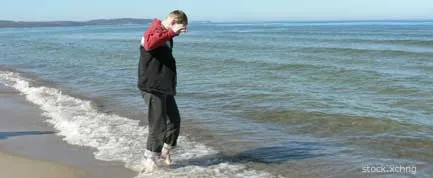
The perils of a day at the beach aren’t always as easy to see as riptides, broken shells and jellyfish—the sand at the shore may harbor E. coli and other potentially dangerous disease-causing bacteria, a recent study showed.
E. coli is one of the main species of bacteria that live in the lower intestines of mammals, including humans—one person excretes billions of them in a day. Pathogenic strains of E. coli can cause vomiting and diarrhea.
Government testers look for E. coli as an indicator of fecal contamination at freshwater beaches all over the country, because the other microbes present are more difficult to detect (another bacteria is used to test for fecal matter at ocean beaches because E. coli does not survive well in salt water).
Beaches all over the country frequently close due to fecal contamination; a day at the beach can be ruined if septic systems overflow or malfunction, or if a lot of birds happen to be in the neighborhood.
Seasonal sources
To test exactly which strains of E. coli were sitting in the sands around Lake Superior, and whether any of them were potentially dangerous to humans, a group of University of Minnesota researchers collected samples and compared the DNA to an existing library.
Their results are detailed in a recent issue of the journal Environmental Science and Technology.
Get the world’s most fascinating discoveries delivered straight to your inbox.
They found two broad types of E. coli in the sand: those “deposited more recently,” as team member Michael Sadowsky put it, and those “that have learned to kind of grow or reproduce in the sand,” he said.
The levels of both of these sources vary seasonally. Those that have become indigenous to the lake sands tend to be more abundant in the summer, when nutrients are more available and temperatures rise. Contributions from birds tend to come when they are migrating through the area. Fecal contamination from sewage can occur whenever there is a malfunction or overflow.
Importantly, the study found that very few of the E. coli present on the beach are potentially harmful to humans—other microbes that tend to travel in the same waste streams, such as Salmonella, are more of a worry to health officials.
But you likely wouldn’t get sick just from wiggling your toes in the sand, because most of these bacteria follow what Sadowsky terms the “fecal to oral route.” Which means you should listen to your parents and wash your hands frequently, especially after using the bathroom and before eating.
“Getting it on your skin is not going to be very dangerous,” he said.
Just watch what you swallow.
- Top 10 Mysterious Diseases
- Is Antibacterial Soap Really Necessary?
- All About Bacteria

Andrea Thompson is an associate editor at Scientific American, where she covers sustainability, energy and the environment. Prior to that, she was a senior writer covering climate science at Climate Central and a reporter and editor at Live Science, where she primarily covered Earth science and the environment. She holds a graduate degree in science health and environmental reporting from New York University, as well as a bachelor of science and and masters of science in atmospheric chemistry from the Georgia Institute of Technology.