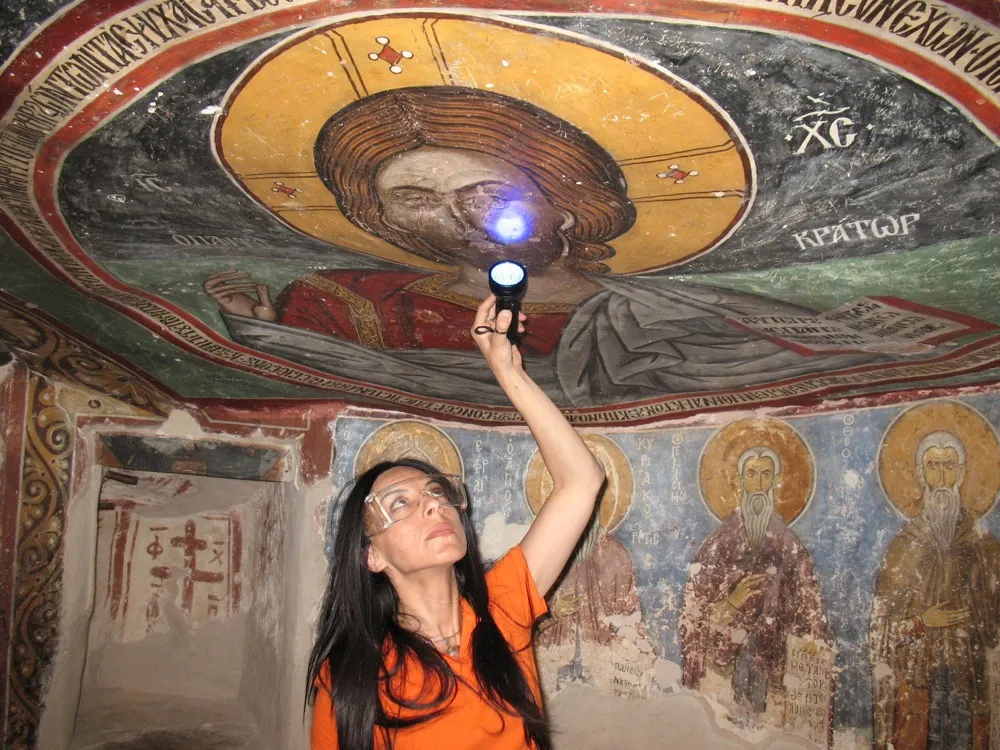
The researchers analyzed some of the paintings on site using various techniques, including infrared, ultraviolet and X-ray fluorescence imaging. Here, UCLA archaeologist Ioanna Kakoulli examines a painting in the monastery under UV light.
Hundreds of years before asbestos became ubiquitous in the construction industry, Byzantine monks used the fibrous material in plaster coatings underlying their wall paintings during the late 1100s, new research shows.
Asbestos is a type of natural, rock-forming mineral known for its ability to separate into long, flexible fibers. It has long been thought that asbestos fibers, which are corrosion- and combustion-resistant, were first integrated into such things as plaster, finish coatings and floors after the Industrial Revolution.
But while investigating the 12th-century paintings in the Byzantine monastery Enkleistra of St. Neophytos in Cyprus, UCLA researchers discovered the magnesium silicate mineral, chrysotile (white asbestos), in the finish coating of the plaster underneath a portion of a wall painting. The chrysotile provided a smooth layer with a mirrorlike surface for the painting. [See Photos of the Byzantine Monastery and 12th-Century Paintings]
"[The monks] probably wanted to give more shine and different properties to this layer," said UCLA archaeological scientist Ioanna Kakoulli, lead author of the new study, published online last month in the Journal of Archaeological Science. "It definitely wasn't a casual decision — they must have understood the properties of the material."
A long history of use
Though all six asbestos minerals are now known to be carcinogenic, people have taken advantage of the fibrous materials' unique properties for millennia. About 4,500 years ago, artisans mixed asbestos minerals with clay to produce stronger pottery. And 2,000 years ago, asbestos fibers were woven into textiles to make fireproof napkins (that were "washed" by tossing them into fire), or to make a special fabric that could separate human ashes from funeral pyre material during cremations, Kakoulli said. "It was considered to have magical powers," she told Live Science.
In the late 19th century, people used asbestos in industrial products — including cements, wall plasters, joint (drywall) compounds, fire-retardant coatings and roofing, among other things — to increase their durability, insulation and weathering protection.
Sign up for the Live Science daily newsletter now
Get the world’s most fascinating discoveries delivered straight to your inbox.
Given this history, Kakoulli and her colleagues weren't expecting to find asbestos on the walls of Enkleistra of St. Neophytos. They initially set out to see if there was any change in the materials used to create the monastery's numerous wall paintings over time.
"We wanted to see how the technological part of making these paintings follows or reveals anything of what we see in their iconography and style," Kakoulli said.
The researchers analyzed some of the paintings on site using various techniques, including infrared, ultraviolet and X-ray fluorescence imaging. They also collected micro-samples of the paintings and further analyzed their molecular and elemental makeup with powerful scanning electron microscopes and other methods.
A surprising find
One of the paintings they inspected depicted the "Enthroned Christ" holding a book with a red frame. When they analyzed the red frame, they found an asbestos-rich layer that was applied as a finish coating between a red paint layer and a plaster layer made up mostly of plant fibers. "So far, we've only found it in relation to those red pigments," Kakoulli said.
They found an asbestos-rich layer in the painting "Enthroned Christ," which would've been applied as a finish coating between a red paint layer and a plaster layer made up mostly of plant fibers.
(Image credit: Ioanna Kakoulli, UCLA)
Interestingly, the main deposits of asbestos in Cyprus come from a high-elevation area approximately 38 miles (60 km) from the monastery, which is near the coast. This location suggests the monks may have been involved in a kind of interregional trade for the asbestos.
The discovery raises many questions, such as why the asbestos was used in this context (and only for the red frame in the painting). It's also curious why the fibrous material apparently wasn't used again in coatings until the 19th century. [Image Gallery: Stunning Byzantine Mosaic]
The scientists are now searching for answers. They plan to return to Cyprus to characterize more of the paintings at Enkleistra of St. Neophytos. Kakoulli also hopes to revisit other wall paintings she's previously studied in Cyprus, to see if they also contained asbestos.
"I have a feeling that it's something that can be easily missed," Kakoulli said. "This was quite an accidental discovery."
Joseph Bennington-Castro is a Hawaii-based contributing writer for Live Science and Space.com. He holds a master's degree in science journalism from New York University, and a bachelor's degree in physics from the University of Hawaii. His work covers all areas of science, from the quirky mating behaviors of different animals, to the drug and alcohol habits of ancient cultures, to new advances in solar cell technology. On a more personal note, Joseph has had a near-obsession with video games for as long as he can remember, and is probably playing a game at this very moment.