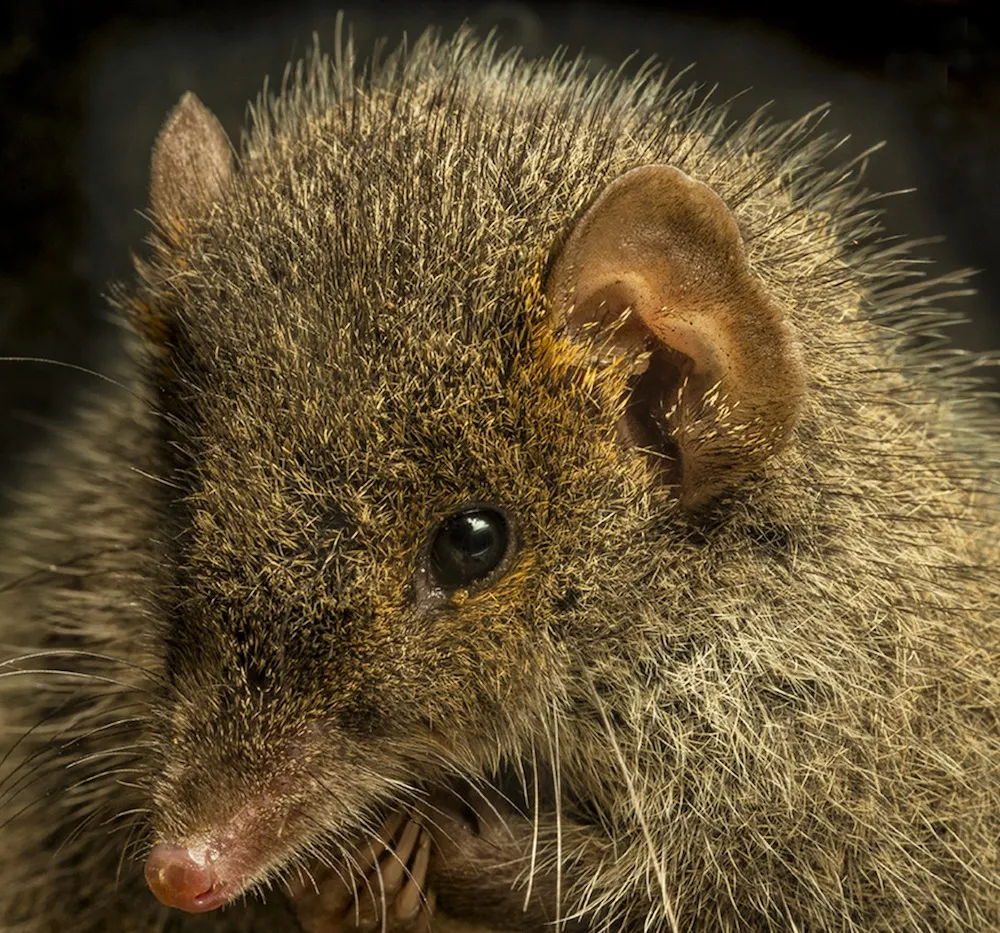
A newly discovered pink-nosed rodentlike marsupial gives its all for sex — really. Males of the species mate so intensely that they die before their young are born.
The creature's discoverers caught the little lothario in Australia's Springbrook National Park with traps baited with peanut butter and oats. They've dubbed it the black-tailed antechinus.
Other members of the antechinus group have already been discovered, some by the same team that found the newest species. Mammalogist Andrew Baker of the Queensland University of Technology had previously found two new species of the genus Antechinus in southeastern Queensland. The discovery of new mammal species is relatively rare, with only a few found each year.
The researchers first saw the black-tailed antechinus in May 2013. It looked unlike the dusky antechinus, a relative that lives in the region, so Baker and his colleagues suspected they had seen something new.
The black-tailed antechinus has orange markings around its eyes and rump.
(Image credit: Gary Cranitch)
"When we caught the first black-tailed antechinus in a trap, we knew we were onto something pretty special," Baker said in a statement.
The black foot of the black-tailed antechinus.
(Image credit: Gary Cranitch)
The new species has a long, black tail and a five-toed foot, also black. The fur around its eyes and rump is yellow-orange, helping distinguish it from other species.
Marsupials in this genus are promiscuous maters. Females give birth to large broods that include offspring from several fathers. To raise their chances of siring more offspring, males mate for hours at a time with many females, Baker said. This sex bacchanalia sends the animals' stress hormone levels skyrocketing, which eventually results in death.
Sign up for the Live Science daily newsletter now
Get the world’s most fascinating discoveries delivered straight to your inbox.
Females collect sperm from their doomed mates all breeding season and then ovulate, allowing for the fertilization of many half-siblings all at once. Some females survive to breed multiple times, but most die after their first litter is weaned. Baker and his colleagues are applying for endangered species protection for the newly discovered marsupial. They published the finding Feb. 17 in the journal Zootaxa.
Stephanie Pappas is a contributing writer for Live Science, covering topics ranging from geoscience to archaeology to the human brain and behavior. She was previously a senior writer for Live Science but is now a freelancer based in Denver, Colorado, and regularly contributes to Scientific American and The Monitor, the monthly magazine of the American Psychological Association. Stephanie received a bachelor's degree in psychology from the University of South Carolina and a graduate certificate in science communication from the University of California, Santa Cruz.