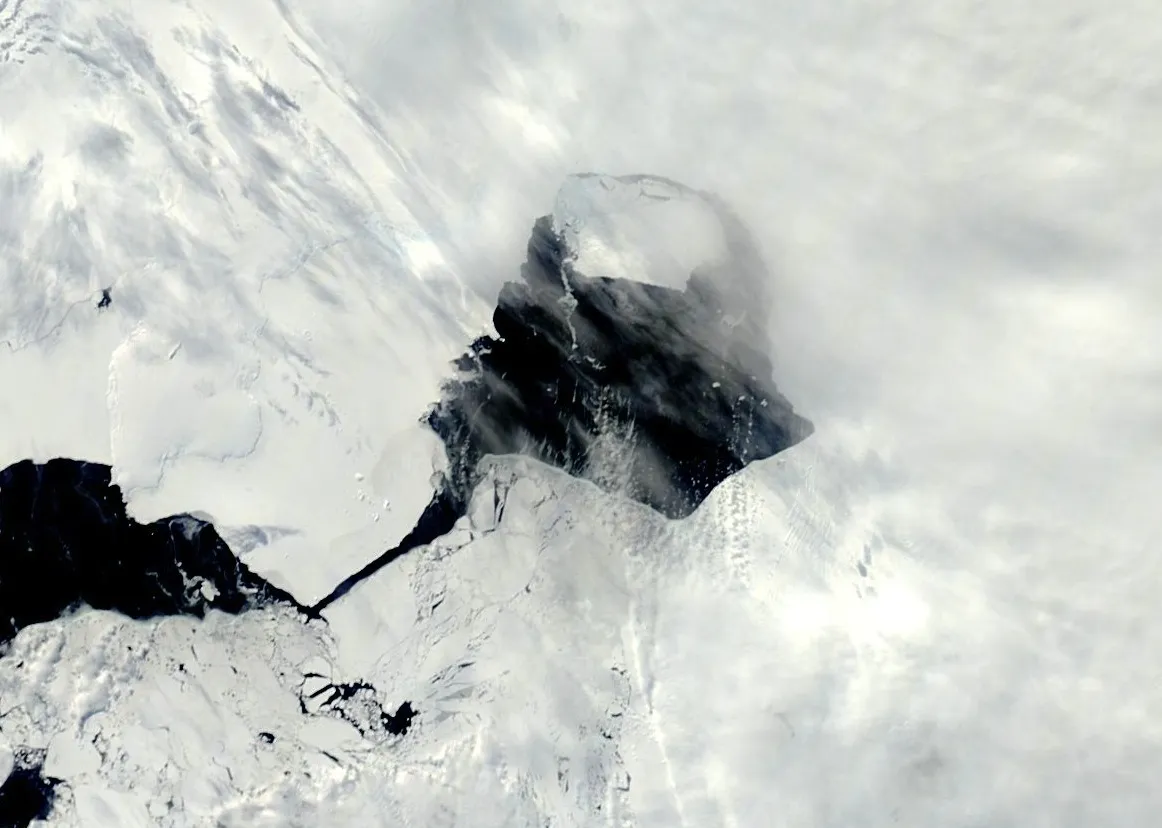
The glacier that contributes more to sea level rise than any other glacier on Antarctica has hit a tipping point of uncontrollable retreat, and could largely collapse within the span of decades, a new study suggests.
Pine Island Glacier accounts for about 20 percent of the total ice flow on the West Antarctic Ice Sheet — an amalgam of glaciers that covers roughly 800,000 square miles (2 million square kilometers) and makes up about 10 percent of the total ice on Antarctica. Many researchers think that, given the size of Pine Island Glacier, its demise could have a domino effect on surrounding glaciers and ultimately — over the course of many years — lead to the collapse of the entire ice sheet, which would raise average global sea level by between 10 and 16 feet (3 and 5 meters). [Photo Gallery: Antarctic's Pine Island Glacier Cracks]
The glacier is not only massive, but also one of the least stable of the West Antarctic Ice Sheet ice flows. In the past 40 years, its melting rate has accelerated due to relatively warm ocean currents that have seeped underneath its base and lubricated its flow seaward. As it slips into the ocean, the glacier's ice shelf — the part that floats on water and extends beyond the glacier's base — disintegrates through a natural process called calving, exposing yet more of the glacier to warm waters. Last year, an iceberg larger than the city of Chicago broke off into the surrounding Amundsen Sea.
Topographic map of Antarctica. The Pine Island Glacier is marked in red.
(Image credit: Angelika Humbert, Alfred Wegener Institute.)
'We have passed the tipping point'
Many researchers have tried to predict the future behavior of this important glacier using mathematical models but, given the complicated nature of glacial dynamics, all of these attempts have been limited and prone to error. Precipitation, wind patterns, atmospheric temperatures, oceanic currents and the shape of bedrock underneath the glacier are only some of the numerous factors that control glacial growth and retreat. Models predicting glacial behavior are therefore very complicated and always prone to some degree of error.
Researchers based at the French National Center for Scientific Research in Grenoble have now developed state-of-the-art models that, while still limited, provide the best estimates yet of the future behavior of Pine Island Glacier, they say. The team has found that the glacier's grounding line — the point where glacier and its ice shelf meet — is about to retreat over an oceanic trench that would increase the amount of water that seeps underneath and melts the glacier. Their models suggest that this would cause the glacier to uncontrollably retreat about 25 miles (40 kilometers) over the next several decades, potentially raising global sea levels by more than 0.4 inches (1 centimeter).
Retreat may slow once the glacier passes the trench, the researchers report, but it will not likely regain stability or enter a positive-growth phase.
Sign up for the Live Science daily newsletter now
Get the world’s most fascinating discoveries delivered straight to your inbox.
"Whatever it will do, we are already engaged in a big change," study co-author Gael Durand told LiveScience. "We have passed the tipping point."
Uncertainties remain
Eric Steig, a glacial geologist at the University of Washington who also studies Pine Island Glacier but was not involved in this study, thinks the study provides the best models yet of this particular glacier's dynamics. Still, he points out that the models make the assumption that melting rates will increase in the near future and that, while this is likely, it is not necessarily a given.
Last month, Steig and colleagues published a paper in the journal Science reporting that Pine Island Glacier's retreat slowed significantly in 2012 due to oceanographic changes related to La Niña. While this seems to have been an anomalous event, Steig says that the 40 years of data gathered on the glacier may not be enough to make accurate predictions about its future behavior, and about what is normal or anomalous for its flow.
"I actually think it's a good assumption that the melt rate will stay high," Steig told LiveScience. "But my confidence that that is right is extremely low and the reason that it is low is that it depends strongly on what happens elsewhere."
For example, La Niña — a weather pattern related to El Niño that brings cold-water masses up the coast of South America, into the central equatorial Pacific, and eventually along the coast of Antarctica — originates as far away as the equatorial tropics, and has a significant impact on the behavior of the glacier. Future work will need to take these distant global factors into account in predicting the behavior of the glacier.
Still, despite these shortcomings, Durand is convinced the glacier has little chance of regaining stability.
"We showed that it will need a very large decrease of the melting condition below the ice shelf and that the oceanographic conditions would need to be much colder than it was before it started its retreat [to maintain stability]," Durand said. "What will come next is an open question, but to recover to its 1990s position is unlikely."
The study findings were detailed earlier this month in the journal Nature Climate Change.
Laura Poppick is a contributing writer for Live Science, with a focus on earth and environmental news. Laura has a graduate certificate in science communication from the University of California, Santa Cruz, and a Bachelor of Science degree in geology from Bates College in Lewiston, Maine. Laura has a good eye for finding fossils in unlikely places, will pull over to examine sedimentary layers in highway roadcuts, and has gone swimming in the Arctic Ocean.