National Marine Sanctuaries are, contrary to what might be expected, among the most stressful places for marine predators to live along the U.S. West Coast, according to a new study.
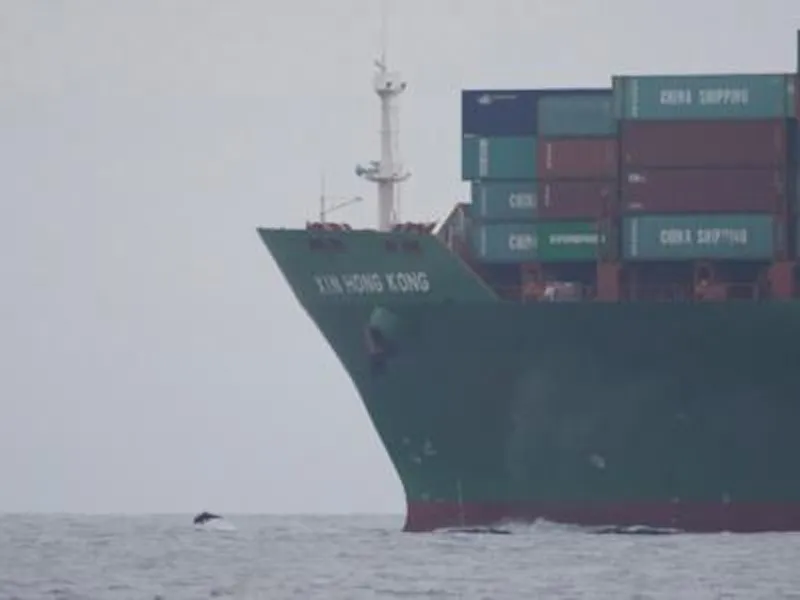
The West Coast swarms with shipping, fishing and recreational boating lanes that can get in the way of marine animals' daily and seasonal travel routes. The cumulative effects of these direct coastal stressors — for example, boat hits to the head — along with indirect stressors of climate change and coastal development, are difficult to quantify but important to consider when developing management plans, researchers say.
Now, a team of scientists based at the University of California, Santa Cruz have conducted the first study that maps the potential cumulative impacts of human activities on marine predators along the West Coast. They focused on animals at the top of the food chain — such as blue whales, California sea lions, leatherback sea turtles and black-footed albatrosses — because these animals play a crucial role in maintaining healthy ecosystems by preying on invasive species and helping to keep biodiversity high.
"What we wanted to do was not just understand where the animals were going, but also where they were likely to be most affected," said study co-author Sara Maxwell, a researcher at Stanford University's Hopkins Marine Station. "We wanted to get the most bang for our buck."The team used existing maps of the travel routes of eight top predators — collected through the Tagging of Pacific Predators (TOPPS) program that has been tracking thousands of marine predators using satellite and light-based geolocator devices since 2000 — and compared these tracks with maps representing the cumulative effect of 24 different human-made stressors to determine where high-stress areas overlap with regions of elevated animal traffic. [Gallery: Ocean Creature Census]
The researchers found that many of the areas with the greatest cumulative negative impacts on the predators fell within National Marine Sanctuaries. This finding was not entirely unexpected, they said, because many of these sanctuaries occur close to shore and, therefore, are more vulnerable to human activity than areas farther from the coast are.
But this does not necessarily mean that the 13 sanctuaries — which span more than 150,000 square miles (390,000 square kilometers) of the U.S. Pacific, Atlantic and Gulf coasts — are not serving their designated purpose, Maxwell said. The sanctuaries were originally created in 1972 to protect marine animals from oil and gas activity, in response to the 1969 Santa Barbara oil spill(the largest oil spill in U.S. waters at the time, but since surpassed in size by the 1989 Exxon Valdez and 2010 Deepwater Horizon spills), Maxwell said. In that sense, they are doing their jobs by limiting oil traffic.
California sea lions are among 23 species whose movements have been tracked since 2000 as part of the Tagging of Pacific Predators program.
(Image credit: Dan Costa, UC Santa Cruz)
Still, other potentially intrusive activities, such as recreational boating and fishing, are not banned in many of the sanctuaries. The terms of each sanctuary are determined by the secretary of the U.S. Department of Commerce and the National Oceanic and Atmospheric Administration (NOAA) through a public comment process, and differ across different sanctuaries. They can, but do not always, restrict or prohibit activities such as using motorized watercrafts, discharging material into the ocean or fishing using bottom trawling.
Sign up for the Live Science daily newsletter now
Get the world’s most fascinating discoveries delivered straight to your inbox.
"That is really surprising to people, but it is not really the fault of the sanctuary," Maxwell told LiveScience. "They are lacking the mandates that would allow them to do that."
The National Marine Sanctuaries Act, which permits the U.S. secretary of commerce to designate new National Marine Sanctuaries, has been amended and reauthorized six times since its inception in 1972. The reauthorization process offers NOAA a chance to call for new annual funding to keep the sanctuaries functional, but regardless of reauthorization, the sanctuaries still technically stay in effect if the reauthorization lapses.
Historically, reauthorization has occurred in five-year increments, but the 2000 reauthorization expired in 2005, and has not since been renewed. This has limited both the amount of funding that Congress can allocate to the sanctuaries and the development of new mandates that would more effectively protect marine predators and the rest of the coastal ecosystem.
Maxwell hopes that the imminent reauthorization of the sanctuaries along the West Coast will present an opportunity to adopt more stringent mandates. The development of at least one new sanctuary spanning the central California coast from Point Arena to the Gulf of the Farallones is in the works, and could potentially incorporate more stringent human-use rules. Maxwell says her team's research, detailed this week in the journal Nature Communications, should help policymakers identify vulnerable regions and develop management plans that protect animals in these regions accordingly.
Laura Poppick is a contributing writer for Live Science, with a focus on earth and environmental news. Laura has a graduate certificate in science communication from the University of California, Santa Cruz, and a Bachelor of Science degree in geology from Bates College in Lewiston, Maine. Laura has a good eye for finding fossils in unlikely places, will pull over to examine sedimentary layers in highway roadcuts, and has gone swimming in the Arctic Ocean.