














From Selfishness to Cooperation: What Drives the Change
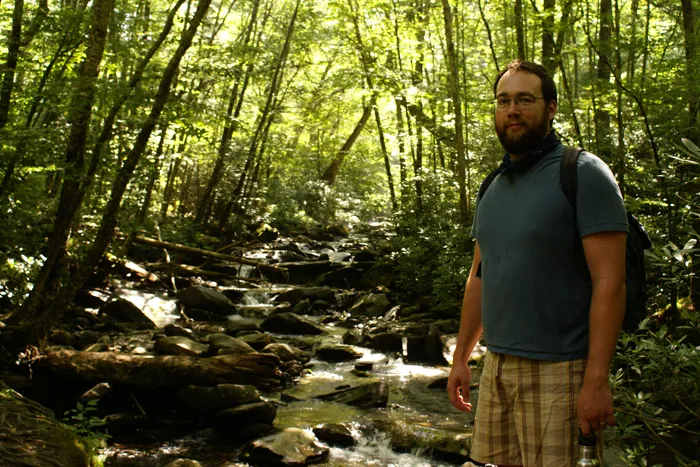
This ScienceLives article was provided to LiveScience in partnership with the National Science Foundation.
Evolutionary biologists seek to resolve the tensions between the evolution and maintenance of cooperative behavior in animals and animals' need to behave "selfishly" to survive. Keenan Mack, a postdoctoral fellow at the National Institute for Mathematical and Biological Synthesis, builds mathematical models to analyze the conditions under which cooperation can evolve. He specifically focuses on how the need to make efficient use of resources might be a basis for cooperation.
Read more about Keenan's research.
Name: Keenan M. L. Mack Age: 32 Institution: National Institute for Mathematical and Biological Synthesis Hometown: Needham, IN Field of Study: Evolutionary ecology
What inspired you to choose this field of study?
I've wanted to be a scientist as long as I can remember; I mean, what kid didn't want to be a paleontologist? … It was really the elegance of evolution as an explanation of the diversity of life that drew me in initially. It just felt like such an important idea that I felt compelled to learn as much as I could about it.
What is the best piece of advice you ever received?
Get the world’s most fascinating discoveries delivered straight to your inbox.
The idea that unless you can effectively explain something to someone, you really don't know it yourself.
What was your first scientific experiment as a child?
I suppose the one that is seared (pun intended) into my memory would be when I was very young … my house was heated with an old cast-iron potbelly stove. I reached out to touch the wall of it, but I didn't know there had been a fire in it very recently, so my mom warned me not to touch the stove because it was hot. Well, I could see that there wasn't a fire going inside it at the moment, so I decided to test her hypothesis, which was promptly confirmed.
What is your favorite thing about being a scientist or researcher?
Definitely my favorite thing about being a scientist is the freedom to pursue new knowledge. Being the first to know something is an incredible feeling.
What is the most important characteristic a scientist must demonstrate in order to be an effective scientist?
I would say the courage to admit they were wrong, even after investing years of work.
What are the societal benefits of your research?
My research helps explain human nature, and provides warnings about how that nature might change in a global society.
Who has had the most influence on your thinking as a researcher?
Probably Jen Rudgers. After I graduated from undergrad, I was sort of lost trying to figure out what to do next. Jen was a post-doc at Indiana University before I was accepted into the grad program there. She's now an associate professor at the University of New Mexico. I worked as a research assistant for her for a little over a year, and during that time she basically taught me how to be a scientist, everything from manuscript writing to experimental design. Without her guidance I never would have gotten the experience I needed to be accepted into graduate school.
What about your field or being a scientist do you think would surprise people first?
Likely, how much of the job requires more writing and math skills than knowing facts about nature.
If you could only rescue one thing from your burning office, what would it be?
I'd grab my portable back-up hard drive, but it would be tough leaving my chess set.
What music do you play most often in your office or car?
In the office I prefer stuff without lyrics, so depending on my mood anything from Budos Band to Tchaikovsky. In the car I like stuff like Phish, Sam Roberts, and The Whitest Boy Alive.
Editor's Note: The researchers depicted in ScienceLives articles have been supported by the National Science Foundation, the federal agency charged with funding basic research and education across all fields of science and engineering. Any opinions, findings, and conclusions or recommendations expressed in this material are those of the author and do not necessarily reflect the views of the National Science Foundation. See the ScienceLives archive.