














'Screaming' Witch Head Nebula Brews Up Baby Stars (Photo)

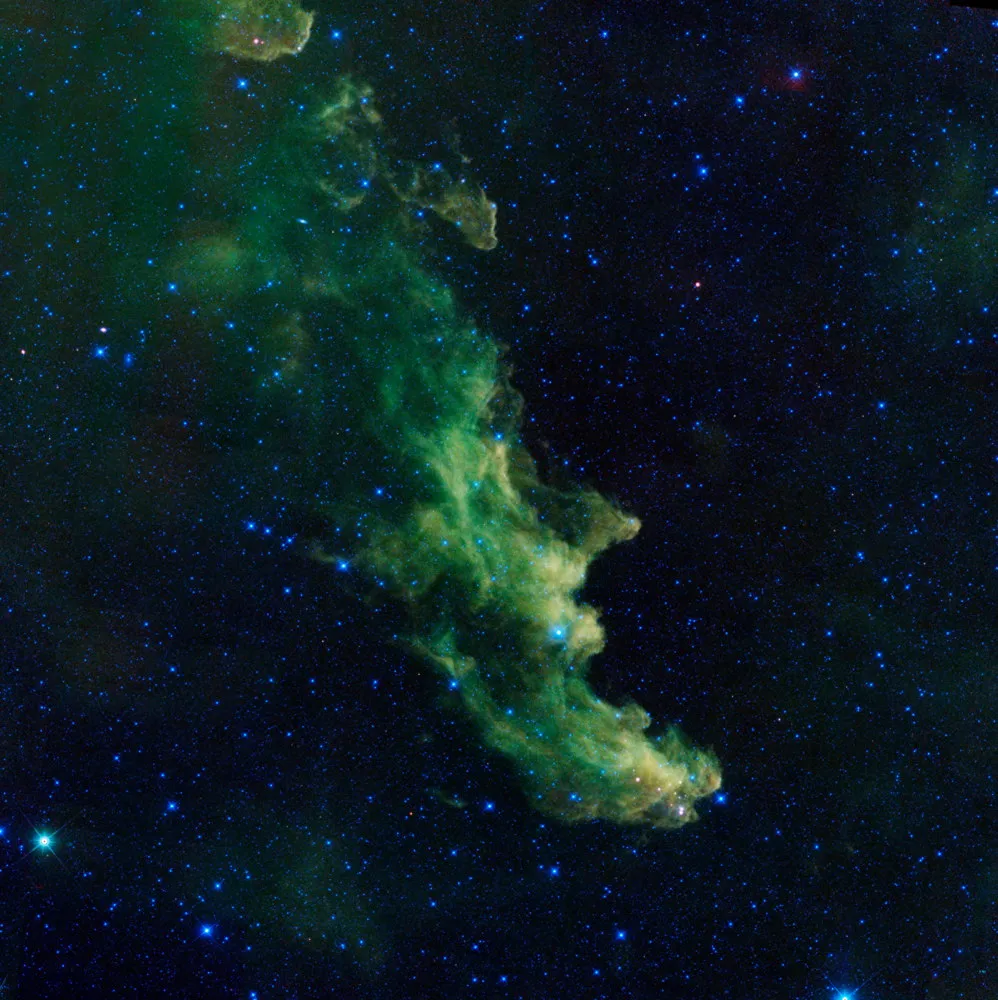
It may look wicked, but a stunning — if not scary — new view of the Witch Nebula unveiled by NASA for Halloween is actually the home of baby stars just beginning their cosmic lives.
The image, taken by NASA's now-retired WISE infrared space telescope, shows a nebula that bears an uncanny resemblance to a wicked witch in profile, hence its name. NASA featured the image as its space photo of the day to mark Halloween today (Oct. 31), noting that the nebula witch appears to be "screaming out in space."
"Astronomers say the billowy clouds of the nebula, where baby stars are brewing, are being lit up by massive stars," NASA officials wrote in an image description. "Dust in the cloud is being hit with starlight, causing it to glow in infrared light, which was picked up by WISE's detectors." [The Spookiest Nebula Photos of All Time (Gallery)]
The Witch Head nebula is hundreds of light-years from earth in the constellation Orion. It can be found near the "knee" of the constellation, NASA officials explained. It's witch-like look is actually an example of pareidolia, in which the human brain recognizes shapes hidden in random images.
There are many nebulas in space with a Halloween twist. The Witch's Broom nebula, which is part of the Veil Nebula 1,500 light-years from Earth, is an obvious associate, but there are also nebula's named after wizards and others that resemble ghosts or even a scary flaming skull.
NASA's WISE space telescope (the name is short for Wide-Field Infrared Survey Explorer) launched in 2009 on a 10-month mission to map the entire sky in infrared light. The $320 million space observatory completed that mission in 2010 and spent another year searching for near-Earth asteroids as part of an extended mission. The spacecraft was retired from active duty in 2011.
Earlier this year, NASA officially revived the WISE space telescope to begin a new hunt for potentially dangerous asteroids that could threaten the Earth. That mission, called NEOWISE, is ongoing.
Get the world’s most fascinating discoveries delivered straight to your inbox.
Email Tariq Malik at [email protected] or follow him @tariqjmalik and Google+. Follow us @Spacedotcom, Facebook and Google+. Original article on SPACE.com.

Tariq is the editor-in-chief of Live Science's sister site Space.com. He joined the team in 2001 as a staff writer, and later editor, focusing on human spaceflight, exploration and space science. Before joining Space.com, Tariq was a staff reporter for The Los Angeles Times, covering education and city beats in La Habra, Fullerton and Huntington Beach. He is also an Eagle Scout (yes, he has the Space Exploration merit badge) and went to Space Camp four times. He has journalism degrees from the University of Southern California and New York University.