















Catfish Hunt on Land
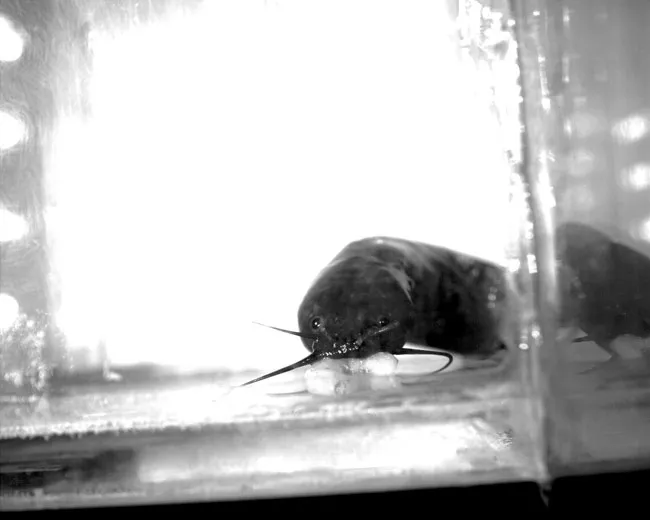
You might think a catfish on land would fare as well as an elephant on roller-skates, but a new study reveals they slither around and adeptly catch insect meals [Video].
The finding helps scientists imagine how ancient fish made their first hunting trips ashore prior to evolving into land creatures.
This study is detailed in the April 13 issue of the journal Nature.
Puddle-jumping hunter
These particular eel catfish, Channallabes apus, live in tropical swamps in Africa, where most of the water is confined to small, acidic pools.
"There's probably more food traveling on land than in these small puddles of mud," said Sam Van Wassenbergh of the University of Antwerp in Belgium. "That's probably why this fish has specialized to go out of water to search for food."
The catfish pick up speed in water and flop onto land, where their flexible vertebral column lets them move around like a snake. They also have a special organ for breathing air without using their gills, although scientists don't quite know how this works.
Get the world’s most fascinating discoveries delivered straight to your inbox.
In water, eel catfish suck in water to capture their prey. But because air is less dense than water, this trick is less effective when hunting on land, and these fish have developed a different approach.
Once they find their terrestrial prey, usually a small beetle or insect, they lift their head and mash at the creepy-crawly with their mouth. The fish nibble at their meal until it's pinned against the ground and they can get a good grip on it.
"They hold their prey firmly in their jaws and go back into the water where they can further digest it," Van Wassenbergh told LiveScience.
Once in the water, the fish can do the normal sucking action to draw a meal deeper into its mouth.
Ancient mobility
Having a mobile neck is key for hunting on land—it allows the catfish to move its head up and down to stab at prey. Mobile necks are a feature usually reserved for land animals called tetrapods.
Recent discoveries of early tetrapods, such as Ichthyostega and Tiktaalik, have revealed that these beasts had mobile necks, and Van Wassenbergh said his catfish study might provide insight to how these early land animals went after food.
"It's hard to speculate about the behavior of fossils, but these animals had strong fins and a mobile neck, and I think there's a very good chance that these were also good terrestrial feeders," Van Wassenbergh said.
- VIDEO: See the Catfish Hunt on Land
- Invention Allows Humans to Breathe Like Fish
- Human Ears Evolved from Ancient Fish Gills
- Giant Water Scorpion Walked on Land
- VOTE! The World's Ugliest Animals
- Save This Ugly Fish