













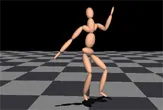
Many people are attracted to hot dancers, and a new study suggests part of the reason is because their bodies are more symmetrical than those of the less coordinated.
The researchers found that men judged to be better dancers tended to have a higher degree of body symmetry, a factor that has been linked to overall attractiveness and health in other research .
The new study involved 183 Jamaican teenagers, ranging between 14-19 years old, who danced while their movements were captured using motion-capture cameras similar to those used in video games and movies to give computer-generated characters fluid movements.
Women watching the recordings preferred the dances of men who were more symmetrical, while men were more impressed by the dances of more symmetric females.
Women are pickier
Interestingly, the male preference for symmetric females was not as strong as that of the female preference for symmetric males. This seems to confirm the theory that women are pickier when selecting a mate, since they bear most of the burden of raising a child, the researchers say.
According to the researchers, their study is the first of its type.
Get the world’s most fascinating discoveries delivered straight to your inbox.
Regular videotape or film can't separate the dance from what the people look like, said study member Lee Cronk, an anthropologist at Rutgers University in New Jersey. "With motion capture, we can do that and get just pure dance movements."
All of us have asymmetries in our bodies. The index finger on one hand might be longer than the other, for example, or the left foot may be slightly larger than the right. Researchers call these fluctuating asymmetries, or FA.
According to one hypothesis, FA is an indicator of an individual's ability to cope with the stresses and pressures associated with body development.
"As you're developing, all sorts of things come at you, like diseases and injury," Cronk told LiveScience. "If you're able to develop symmetry despite all of that, then that would indicate to others that you have what it takes to make a go of it in that environment."
Body advertising
A high degree of body symmetry serves as a subtle advertisement of genetic quality and health, the thinking goes.
While most people don't go around measuring and comparing body parts of potential mates, it's thought that we pick up on these cues subconsciously. The idea that there is an association between body symmetry and health comes from various animal and human studies. Peahens and barn swallows prefer males with more symmetrical tails. One study found that women experience more orgasms during sex with male partners whose features are more symmetrical, regardless of the level of romantic attachment or the sexual experience of the guy.
What's any of this got to do with dancing?
The researchers speculate that higher body symmetry might also indicate better neuromuscular coordination. This may influence dance ability since attractive dances can be more rhythmic and more difficult to perform.
The study, led by William Brown of Rutgers, was detailed in the Dec. 22 issue of the journal Nature.