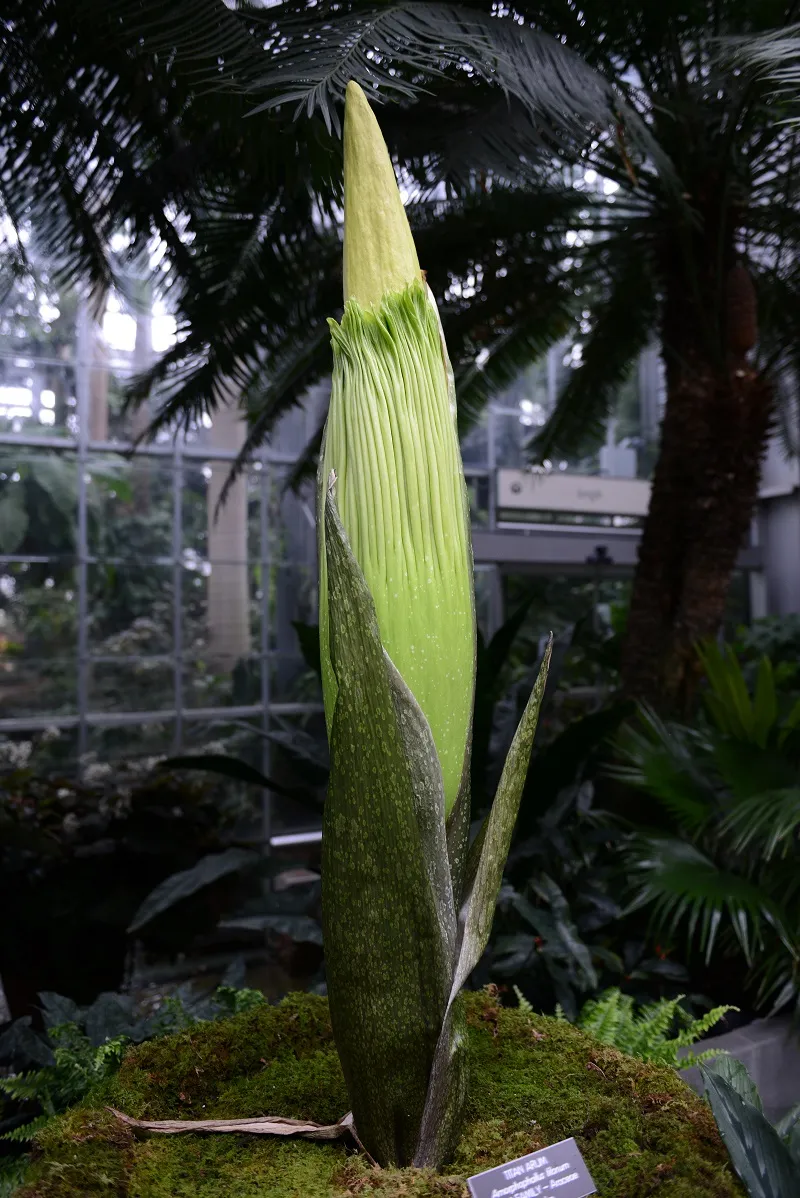
This image shows the corpse flower on display at the U.S. Botanic Garden Conservatory as it was Friday, July 12. The foul-smelling plant it about to reach peak bloom.
One of the world's worst smelling flowers is about to make a stink in Washington, D.C.
A towering specimen of the titan arum, or corpse flower, went on display at the U.S. Botanic Garden Conservatory Thursday (July 11), as the plant is about to hit peak bloom — a rare and brief spectacle that reeks like rotting flesh.
As of Friday morning, Washington's corpse flower was still closed up. Officials at the conservatory said their best guess for the bloom is this weekend, though rain and cool temperatures could push back the peak until early next week. The fetid flower will only be fully open for 24 to 48 hours. Then, it will quickly collapse.
The malodorous flowering of the titan arum is unpredictable and there are often a few years, sometimes even a few decades, between blooms. The U.S. Botanic Garden has not displayed a blooming titan arum since 2007.
(Image credit: Jeff Hillyer Western Illinois University)
The titan arum, scientifically named Amorphophallus titanium, is native to the steamy rain forests of central Sumatra in western Indonesia and was first discovered by researchers in 1878.
The darkly colored "petal" that opens up during bloom is called a spathe, and plant's tube-like spike at its center is called a spadix. The bloom is not actually made up of a single flower, but rather thousands of little flowers in a cluster that botanists call an inflorescence. The titan arum's inflorescence is the largest in the world, often taller than 10 feet (3 meters).
There's a clever evolutionary strategy behind its putrid smell. In the wild, the odor and warmth attract flesh-eating pollinators like flies and carrion beetles from far and wide. The insects head to the bottom of the spadix and by the time they escape, they are coated with pollen. Then, they unwittingly do the plant's dirty work, flying off to cross pollinate a new titan arum in bloom.
Sign up for the Live Science daily newsletter now
Get the world’s most fascinating discoveries delivered straight to your inbox.
Megan has been writing for Live Science and Space.com since 2012. Her interests range from archaeology to space exploration, and she has a bachelor's degree in English and art history from New York University. Megan spent two years as a reporter on the national desk at NewsCore. She has watched dinosaur auctions, witnessed rocket launches, licked ancient pottery sherds in Cyprus and flown in zero gravity. Follow her on Twitter and Google+.