A car crash-like collision between tectonic plates offshore of Colombia helps explain the region's unusual geology, a new study finds.
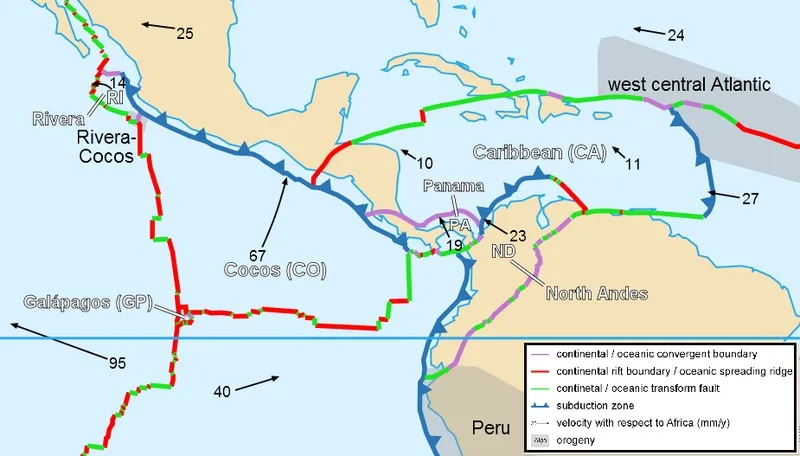
Colombia sits at the complex junction of three small tectonic plates: the Caribbean plate to the north, the Panama plate to the west and the Nazca plate to the southwest. All of them border the northwestern corner of the giant South America plate.
Both the Caribbean plate and the Nazca plates meet South America as subduction zones, sliding down beneath the continent. But the Panama plate, which carries a big, thick stack of old volcanoes, is hitting Colombia like a side-impact collision, according to a study published in the June 2013 issue of the journal Bulletin of the Seismological Society of America.
"[The Panama block] acts as an indenter, causing internal deformation of central and northern Colombia," study co-author Paul Mann, a geologist at the University of Houston, said in an email interview.
The balky pile of volcanoes refuses to slide easily down into the subduction zone between the Panama plate and the South America plate, the researchers said. "The thicker crust of the Panama block is less bendable," Mann said.
Because the thick crust is stuck, the Panama plate is tearing apart. This break in the oceanic crust, which the researchers call the "Caldas tear," can be seen in seismic waves, which change speed as they travel through warmer or colder material below the surface.
A tectonic map of northwestern South America and Panama showing plate boundaries and 30,000 earthquakes from the Colombian Seismic Network.
(Image credit: BSSA)
The tear is about 150 miles (240 kilometers) long and oriented east to west, along the border between the Panama and Nazca plates. The researchers think this creates the unusual earthquake pattern called the Bucamaranga nest, a dense area of seismic activity at about 86 miles (140 km) depth.
Sign up for the Live Science daily newsletter now
Get the world’s most fascinating discoveries delivered straight to your inbox.
The tectonic shoving match has created a symmetrical V-shaped pattern of faults on the land in Colombia, centered on the impact. The Caldas tear is also reflected in Colombia's landscape, the researchers said. Small volcanoes aligned with the tear have an unusual chemical composition that could be related to the break, they said.
Mann said he hopes to further explore how the tear in the Panama plate changed Colombia's geology, such as altering river gradients. Colombia has Earth's highest coastal mountain range, the Sierra Nevada de Santa Marta.
Becky Oskin covers Earth science, climate change and space, as well as general science topics. Becky was a science reporter at Live Science and The Pasadena Star-News; she has freelanced for New Scientist and the American Institute of Physics. She earned a master's degree in geology from Caltech, a bachelor's degree from Washington State University, and a graduate certificate in science writing from the University of California, Santa Cruz.