















Images: Stingray Sex, Mini-Horses & Other Curiosities of Fossil Lake

Lone Frog

The creatures in this gallery were all entombed at the bottom of Wyoming's long-gone Fossil Lake, which was teeming with life during the early Eocene, about 52 million years ago. Only one frog has ever been found at the formation. The single specimen pictured here measures just 1.6 inches (4 cm) long. It has yet to be given a taxonomic classification by scientists.
Monitor Lizard

Skin and neck cartilages are preserved in this monitor lizard fossil, which appears to have swallowed one of its teeth. This specimen represents a primitive species of the diverse varanid lizards, which counts the Komodo dragon among its 50 living species.
Mini-Horse

This is the most complete skeleton of a so-called dawn horse ever discovered. This specimen of Protorohippus venticolus was much more diminutive than today's horses, standing less than two feet high at the shoulder, but its long back legs suggest it was a good jumper. Perhaps it was less skilled as a swimmer; researchers aren't sure how the horse ended up at the bottom of the middle of Fossil Lake but they suspect it drowned, possibly trying to escape a predator.
Long-Tailed Turtles

These two adult fossilized turtles, each more than 4 feet long, belong to the species Christernon undatum. They are part a family of turtles known as Baenidae, which have only been found in North America and have extremely long tails. The animals didn't have the ability to tuck their heads into their shells; that's why all of the complete skeletons of these turtles from Fossil Lake have their heads poking out. Baenids flourished during the Late Cretaceous but became extinct in the late Eocene, meaning the specimens shown here represent some of the last survivors of their kind.
Stingray Sex
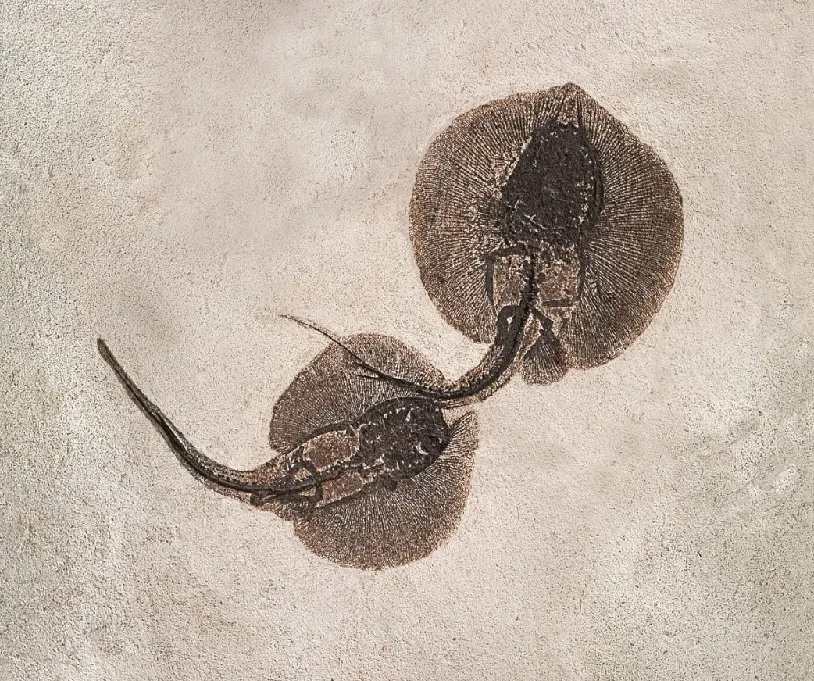
This fossil immortalizes stingray sex of the Eocene. The male and female fat-tailed stingrays (Asterotrygon maloneyi) shown here were likely mating or just about to mate when they were killed, researchers believe.
Arboreal Mammal

Specimens of this small arboreal mammal, Apatemys chardini, are rarely found in the Fossil Butte deposits. Researchers think this particular creature may have been dropped by a predator or swept to its deathbed by a tributary river that flowed into Fossil Lake. It's pictured here with a common, herring-like fish of the era, Knightia eocaena.
Caiman Alligator

Crocodilians make their debut in the fossil record about 84 million years ago. This one from Fossil Lake is a small caiman alligator, given the name Tsoabichi greenriverensis.
Get the world’s most fascinating discoveries delivered straight to your inbox.
Caiman Alligator

This is another specimen of the extinct Tsoabichi greenriverensis. It measures only about 2-and-a-half feet long, but there were more fearsome crocodilian species in Fossil Lake during the early Eocene that stretched 13 feet in length.
Snakes

These specimens of Boavus idelmani, a now extinct relative of the boa constrictor, represent two of the three individual snakes that have been found in the Fossil Butte Member. The bottom image shows the holotype specimen, which was found in the early 20th century, ended up in a private collection and is now lost.
Tree-Loving Mammal

The incredibly long tail on this creature has the largest number of vertebrae of any known mammal, but researchers don't know what species this is. They think it's a tree-climbing carnivore in the extinct mammal family Cimolestidae.
