













New Software Helps Track Endangered Tigers

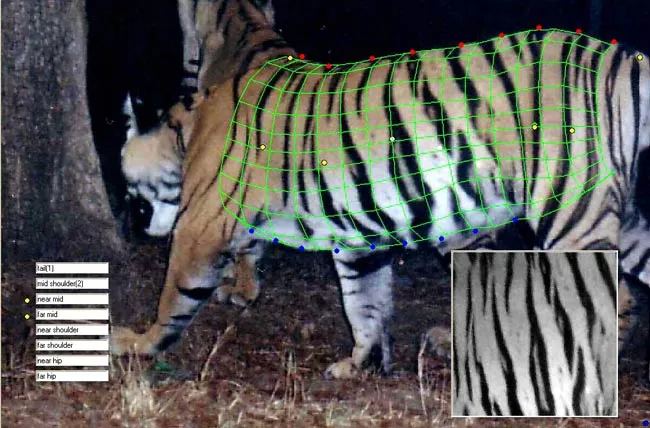
Tigers in the wild are now being rapidly identified, counted and tracked by conservation scientists who are creating 3-D models of the animals from photos snapped by remote cameras.
Researchers currently calculate tiger populations by painstakingly reviewing hundreds of photos of animals caught by camera "traps" and then matching their individual stripe patterns, which are unique to each animal.
Using a new formula developed by tiger expert Ullas Karanth of the Wildlife Conservation Society, researchers can accurately estimate local populations by how many times individual tigers are "recaptured" by the camera trap technique.
The new software, developed by Conservation Research Ltd., creates a 3-D model from scanned photos using algorithms similar to fingerprint-matching software used by criminologists. It could help speed up tiger conservation efforts.
"This new software will make it much easier for conservationists to identify individual tigers and estimate populations," Karanth said. "The fundamentals of tiger conservation are knowing how many tigers live in a study area before you can start to measure success."
A study testing the software, detailed online on March 11 in the journal Biology Letters, found that the technique was up to 95 percent accurate in matching tigers from scanned photos.
Researchers were also able to use the software to identify the origin of confiscated tiger skins based solely on photos. Poached tigers often end up in China and Southeast Asia, where they are used in some traditional Chinese medicines.
Get the world’s most fascinating discoveries delivered straight to your inbox.
Tigers are endangered in India, Nepal, Indonesia, Russia, China and elsewhere largely due to habitat destruction, poaching and loss of prey.
Development of the software was funded through a Panthera project in collaboration with WCS. The study was partly funded by a grant from the Liz Claiborne / Art Ortenberg Foundation. The WCS's tiger conservation work is also funded by the U.S. Geological Survey, the U.S Fish and Wildlife Service's Rhino-Tiger Conservation Fund, and private contributions.
- Top 10 Deadliest Animals
- Tiger News, Images and Information
- Images: Endangered Wildlife
