














Why Doesn't Plastic Biodegrade?

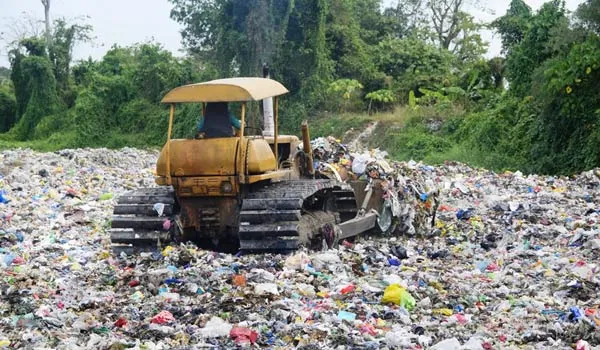
Most plastic is manufactured from petroleum the end product of a few million years of natural decay of once-living organisms. Petroleum's main components come from lipids that were first assembled long ago in those organisms' cells. So the question is, if petroleum-derived plastic comes from biomaterial, why doesn't it biodegrade?
A crucial manufacturing step turns petroleum into a material unrecognized by the organisms that normally break organic matter down.
Most plastics are derived from propylene, a simple chemical component of petroleum. When heated up in the presence of a catalyst, individual chemical units monomers of propylene link together by forming extremely strong carbon-carbon bonds with each other. This results in polymers long chains of monomers called polypropylene.
"Nature doesn't make things like that," said Kenneth Peters, an organic geochemist at Stanford University, "so organisms have never seen that before."
The organisms that decompose organic matter the ones that start turning your apple brown the instant you cut it open "have evolved over billions of years to attack certain types of bonds that are common in nature," Peters told Life's Little Mysteries.
"For example, they can very quickly break down polysaccharides to get sugar. They can chew up wood. But they see a polypropylene with all its carbon-carbon bonds, and they don't normally break something like that down so there aren't metabolic pathways to do it," he said.
But if all you have to do to make propylene subunits turn into polypropylene is heat them up, why doesn't nature ever build polypropylene molecules?
Feed your curiosity with an exclusive mystery every week, solved with science and delivered direct to your inbox before it's seen anywhere else.
According to Peters, it's because the carbon-carbon bonds in polypropylene require too much energy to make, so nature chooses other alternatives for holding together large molecules. "It's easier for organisms to synthesize peptide bonds than carbon-carbon bonds," he said. Peptide bonds, which link carbon to nitrogen, are found in proteins and many other organic molecules.
Environmentalists might wonder why plastic manufacturers don't use peptide bonds to build polymers rather than carbon-carbon bonds, so that they'll biodegrade rather than lasting forever in a landfill . Unfortunately, while peptide bonds would produce plastics that biodegrade, they would also have a very short shelf life. "It's an issue of 'you can't have your cake and eat it too,'" said Jim Coleman, chief scientist at the US Geological Survey Energy Resources Program. "When you buy a plastic jar of mayonnaise, you want [the jar] to last a few months." You don't want it to start decomposing before you've finished the mayo inside.
Peters explained that some disposable plastic products which don't need a very long shelf life are synthesized with peptide bonds in their chemical composition. "But a carbon-carbon linkage will be more stable, so it depends on what people are trying to make."
- How Environmentally Friendly Is Plastic?
- What Happens in a Landfill?
- Does Recycling Plastic Cost More than Making It?
Got a question? Send us an emailThis e-mail address is being protected from spambots. You need JavaScript enabled to view it This e-mail address is being protected from spambots. You need JavaScript enabled to view it This e-mail address is being protected from spambots. You need JavaScript enabled to view it This e-mail address is being protected from spambots. You need JavaScript enabled to view it This e-mail address is being protected from spambots. You need JavaScript enabled to view it This e-mail address is being protected from spambots. You need JavaScript enabled to view it This e-mail address is being protected from spambots. You need JavaScript enabled to view it This e-mail address is being protected from spambots. You need JavaScript enabled to view it This e-mail address is being protected from spambots. You need JavaScript enabled to view it This e-mail address is being protected from spambots. You need JavaScript enabled to view it and we'll crack itThis e-mail address is being protected from spambots. You need JavaScript enabled to view it . Follow Natalie Wolchover on Twitter @nattyover

Natalie Wolchover was a staff writer for Live Science from 2010 to 2012 and is currently a senior physics writer and editor for Quanta Magazine. She holds a bachelor's degree in physics from Tufts University and has studied physics at the University of California, Berkeley. Along with the staff of Quanta, Wolchover won the 2022 Pulitzer Prize for explanatory writing for her work on the building of the James Webb Space Telescope. Her work has also appeared in the The Best American Science and Nature Writing and The Best Writing on Mathematics, Nature, The New Yorker and Popular Science. She was the 2016 winner of the Evert Clark/Seth Payne Award, an annual prize for young science journalists, as well as the winner of the 2017 Science Communication Award for the American Institute of Physics.