














Bastion of Galapagos Life Spied from Space

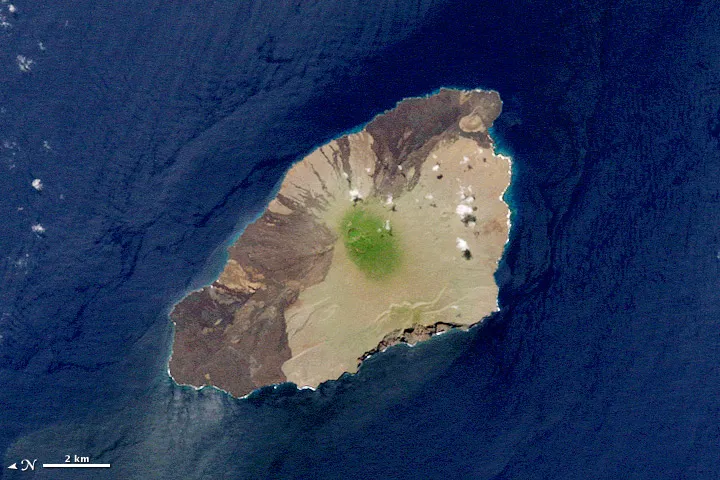
Pinta Island, the northernmost isle of the Galapagos Archipelago, may be tiny, but the miniscule volcanic island hosts an outsize number of unique species — one of which recently went extinct.
Lonesome George, the single surviving member of a subspecies of Galapagos tortoise found only on Pinta Island, recently died, leaving the famed chain of islands with only 10 unique tortoise subspecies.
Although Pinta Island is a mere 23 square miles (60 square kilometers) across, and accounts for just 1 percent of the Galapagos Islands' area, it is home to nearly one-third of the islands' unique plant species.
In a NASA satellite photograph, a light dusting of green is visible along the island's outer edges, signs of the forest and grasslands that grow in the dry climate.
The darkest green — marking the island's densest vegetation — is centered around Pinta's volcanic peak, where higher elevations and moister conditions allow more plants to thrive.
Pinta's biological diversity springs not only from the island's variety of ecosystems, but also from its relative isolation from the archipelago's other islands, whose unique animal residents inspired Darwin's theories of natural selection.
The islands' biological riches were plundered for centuries, until 1959, when Ecuador made the entire region a national park.
Get the world’s most fascinating discoveries delivered straight to your inbox.
Feral goats, introduced to Pinta Island in the 1950s, took a steep toll on the island's unique vegetation, but after a successful eradication program that ended in the 1990s, the island is now goat-free.
The Galapagos Islands were declared a United Nations World Heritage Site in 1978. In 2007, the archipelago was declared a site "in danger," according to the U.N. committee, due to an influx of invasive species and tourists, and an increase in over-fishing. Yet just three years later, in 2010, the Galapagos were removed from the Danger List.
Follow OurAmazingPlanet for the latest in Earth science and exploration news on Twitter @OAPlanet. We're also on Facebook & Google+.
