














'Hair of the Bear' Census Counts Grizzlies

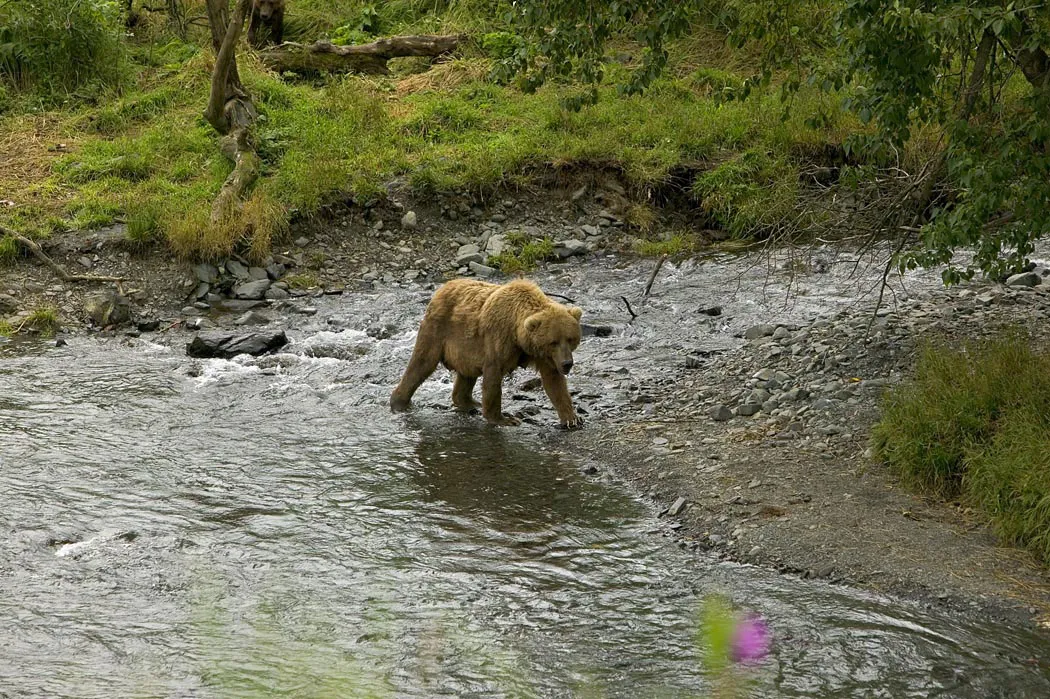
At least 40 grizzly bears are thought to make their homes in the far northwest corner of Montana and northeastern Idaho, but getting an exact count is tricky. Researchers are hoping for a more accurate assessment this summer based on the grizzlies' fur.
Individual bears will be identified by DNA in hair collected from more than 1,200 natural objects that bears like to rub against, such as trees, posts and poles, plus almost 800 scent-baited "hair corrals."
Such a "hair of the bear" study was used to estimate the size and distribution of the grizzly bears in the Glacier National Park-Bob Marshall Wilderness complex in northern Montana.
At the bear rubs, small strips of wire are attached to the rubbed surface to facilitate hair collection.
The hair corrals are set up by encircling a group of trees with 100 feet of barbed wire and pouring liquid scent in the center of the wire corral. When a bear passes under or over the wire to investigate the source of the odor, the barbs collect the bear's hair.
The DNA collected will provide detailed information about the distribution of the population and expand the genetic database for grizzly bears in the Cabinet-Yaak Ecosystem. A 2,600-square-mile area of the ecosystem is one of the six recovery zones defined by the U.S. Fish and Wildlife Service's Grizzly Bear Recovery Plan.
"Getting accurate counts of infrequently encountered animals in the wild is always a challenge, especially when individuals are difficult to distinguish from one another," said U.S. Geological Survey director Marcia McNutt in a statement. "The great advantage of using DNA for counting is that it not only distinguishes individuals reliably, but also can determine how related or inbred a population has become, an important parameter in monitoring genetic diversity in the wild."
Get the world’s most fascinating discoveries delivered straight to your inbox.
Fieldwork to set up the scent-baited hair traps and collect hair from the wire corrals and network of bear rubs is to begin June 7. The study area extends beyond the recovery zone to include all 2.4 million acres thought to be occupied by grizzly bears in the Cabinet-Yaak Ecosystem.
The project is a collaborative effort among city, county, tribal, federal and state agencies, as well as partners from private industry and the nonprofit sector.
