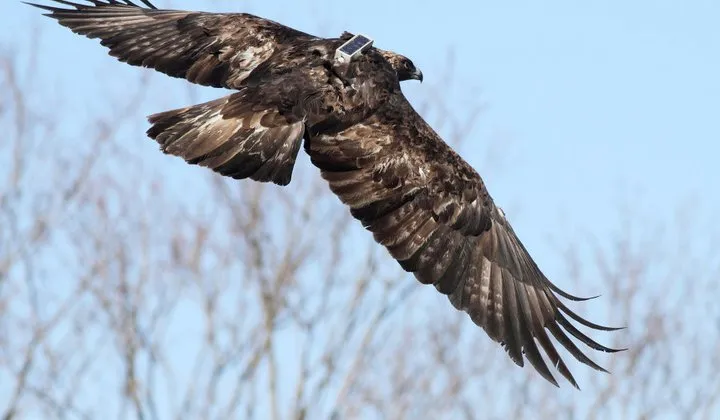
Fitted with a telemetry unit, a golden eagle takes flight near the N.Y./Conn. border in March of 2011. Data collected from the bird one year later reveals a northern migration to the far reaches of Canada.
A rare golden eagle that was rehabilitated after it was found wounded in New York last year has been tracked since its release all the way back to where it was originally found.
The eagle was found in Amenia, N.Y., by snowmobilers in February 2011. It had suffered multiple puncture wounds on its left leg, likely caused by an animal it was trying to capture. Its left foot was also injured. It was transferred to the Tufts Wildlife Center in North Grafton, Mass., for treatment and made a full recovery.
Last March, it was released from Tufts, but not before Todd Katzner, a research assistant professor at West Virginia University who studies the species' migratory habits, outfitted it with a GPS-GSM telemetry unit and a tracking band.
The path the golden eagle took after it was released in March 2011.
(Image credit: Tufts Wildlife Center)
While the golden eagles are not endangered, they are rarely seen in the eastern parts of North America. Sightings in New York and New England are exceedingly rare, and occur only during migrations. The birds are often 50 percent larger than bald eagles, with wingspans that surpass 7 feet (2 meters).
The tracking data has revealed the bird’s flight pattern over the past year: After its release, the bird remained near Amenia for about two weeks before beginning its northern trek, traveling not far from the St. Lawrence River, and then crossing part of the Labrador Peninsula into the northern reaches of Quebec. As winter set in, the golden eagle then headed south, resting near the area where it was found.
Data now reveals that the bird has begun its return northward to the Quebec/Labrador breeding grounds.
The migratory route taken by the golden eagle back towards New York in the fall.
(Image credit: Tufts Wildlife Center)
"It's extremely gratifying to all of us here at Tufts Wildlife Clinic to learn that this beautiful bird is doing well and living out its life in the wild, as it should be," said Dr. Florina Tseng, director of Tufts Wildlife Clinic.
Sign up for the Live Science daily newsletter now
Get the world’s most fascinating discoveries delivered straight to your inbox.
For the science geek in everyone, Live Science offers a fascinating window into the natural and technological world, delivering comprehensive and compelling news and analysis on everything from dinosaur discoveries, archaeological finds and amazing animals to health, innovation and wearable technology. We aim to empower and inspire our readers with the tools needed to understand the world and appreciate its everyday awe.