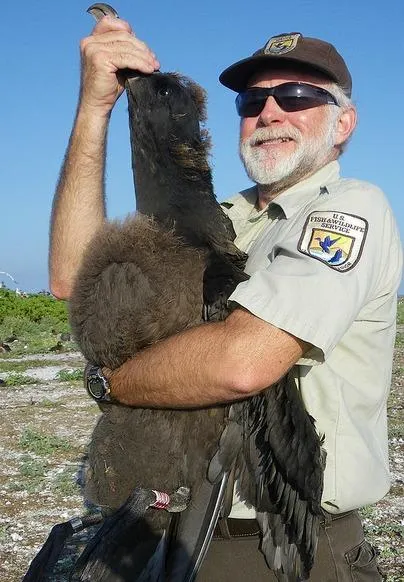
On Midway Atoll, a tiny island about 1,250 miles (2,000 kilometers) northwest of Honolulu, a rare short-tailed albatross chick has had it tough during its brief life.
The first of its kind born outside Japan, the bird hatched in January in the middle of a raging storm. Then in February, another gale tossed the chick nearly 100 feet (30 meters) from its nest. In March, the young bird survived a tsunami, sparked by the devastating earthquake in Japan, which killed about 100,000 albatross chicks on the Pacific island.
"This chick is a survivor," said John Klavitter, deputy manager of the Midway Atoll National Wildlife Refuge.
And now biologists are betting the chick's track record may help them track the rare and endangered species. Refuge staffers have affixed permanent bands to the five-month-old chick's legs, allowing scientists to follow along as the bird matures and takes flight.
"We are very excited that the chick, raised by first-time parents, has made it to where we believe it will fledge, perhaps by mid-June," Klavitter said.
The young albatross on banding day.
(Image credit: U.S. Fish and Wildlife Service/David Dow.)
Albatross fledglings spend their first two to seven years at sea before returning to land to find a mate.
The short-tailed albatross once numbered in the millions, but were hunted to near-extinction for their feathers and other parts. By 1939, only 10 birds were known to remain.
Sign up for the Live Science daily newsletter now
Get the world’s most fascinating discoveries delivered straight to your inbox.
In 2007, it was estimated there were around 2,360 short-tailed albatross worldwide.
Over the last decade, biologists from the Midway refuge and Japan have collaborated to stabilize and increase the population.
In 2000 and 2001, 42 short-tailed albatross decoys (some supplied by Japanese researchers) were placed on the refuge in the vicinity of a 12-year old male that first arrived on the island in 1999.
Biologists hoped the decoys and a solar-powered, automated short-tailed albatross call would attract more live birds and a mate for the male.
Seven years later, a five-year old female arrived. The male finally had a mate.
"This amazing chick is the result," Klavitter said.
For the science geek in everyone, Live Science offers a fascinating window into the natural and technological world, delivering comprehensive and compelling news and analysis on everything from dinosaur discoveries, archaeological finds and amazing animals to health, innovation and wearable technology. We aim to empower and inspire our readers with the tools needed to understand the world and appreciate its everyday awe.