The Danube: Europe's Best Preserved River Delta
Get the world’s most fascinating discoveries delivered straight to your inbox.
You are now subscribed
Your newsletter sign-up was successful
Want to add more newsletters?
Delivered Daily
Daily Newsletter
Sign up for the latest discoveries, groundbreaking research and fascinating breakthroughs that impact you and the wider world direct to your inbox.
Once a week
Life's Little Mysteries
Feed your curiosity with an exclusive mystery every week, solved with science and delivered direct to your inbox before it's seen anywhere else.
Once a week
How It Works
Sign up to our free science & technology newsletter for your weekly fix of fascinating articles, quick quizzes, amazing images, and more
Delivered daily
Space.com Newsletter
Breaking space news, the latest updates on rocket launches, skywatching events and more!
Once a month
Watch This Space
Sign up to our monthly entertainment newsletter to keep up with all our coverage of the latest sci-fi and space movies, tv shows, games and books.
Once a week
Night Sky This Week
Discover this week's must-see night sky events, moon phases, and stunning astrophotos. Sign up for our skywatching newsletter and explore the universe with us!
Join the club
Get full access to premium articles, exclusive features and a growing list of member rewards.
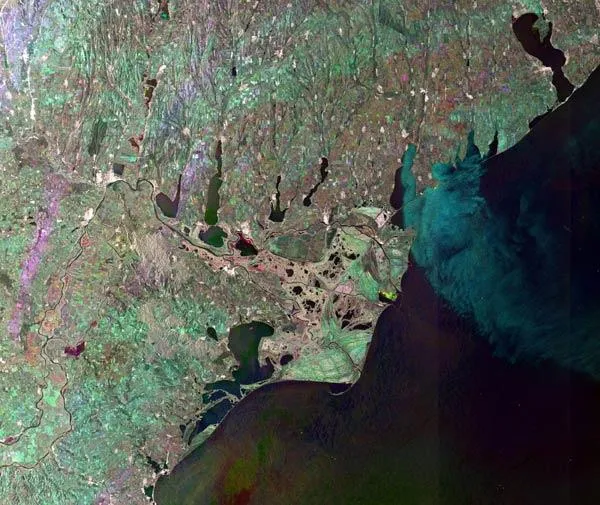
The delta of the Danube River, Europe's best preserved river delta, can be seen in this image taken by the European Space Agency's (ESA) Envisat satellite earlier this year.
The Danube originates in the Black Forest in Germany as the smaller Brigach and Breg rivers, which converge to form the mighty Danube. Flowing southwest for more than 1,740 miles (2,800 kilometers), it finally pours into the Black Sea via the delta.
Designated a World Natural Heritage Site in 1991, the Danube Delta is a labyrinth of river channels, lakes, bays, floodplains, marsh and reed beds. This vast triangular delta is home to an extremely rich variety of birds, fish, animals and plants.
The delta protrudes into the Black Sea owing to the continual deposition of alluvial material and is continuing to grow seawards at a rate of up to 100 feet (30 meters) per year, according to an ESA statement.
The natural reserve lies largely in Romania, which is set to be ESA's newest Member State.
Get the world’s most fascinating discoveries delivered straight to your inbox.