














Bahamas from Above: Brilliant Blues and Sandy Shores

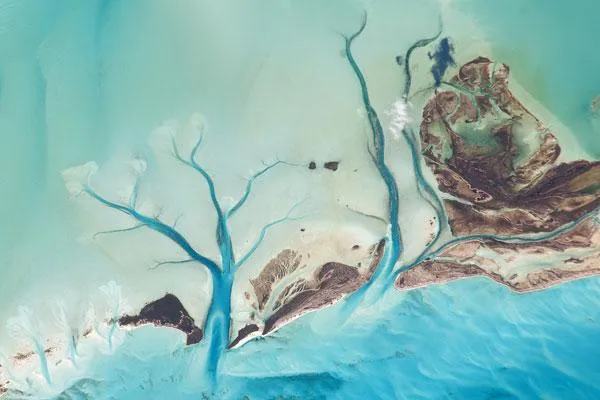
The islands of the Bahamas are situated on large depositional platforms the Great and Little Bahama Banks composed mainly of carbonate sediments ringed by reefs. The islands are the only parts of the platform currently exposed above sea level.
The sediments were formed mostly from the skeletal remains of organisms settling to the sea floor; over geologic time, these sediments consolidated to form carbonate sedimentary rocks such as limestone.
This astronaut photograph provides a view of tidal flats and channels near Sandy Cay, on the western side of Long Island and along the eastern margin of the Great Bahama Bank. The continuously exposed parts of the island are brown, a result of soil formation and vegetation growth.
To the north of Sandy Cay, an off-white tidal flat composed of carbonate sediments is visible; light blue-green regions indicate shallow water on the tidal flat. The tidal flow of seawater is concentrated through gaps in the land surface, leading to the formation of relatively deep channels that cut into the sediments. The channels and areas to the south of the island have a vivid blue color that indicates deeper water.
- Natural Art: The Ocean Blooms
- The World's Biggest Oceans and Seas
- Observing Earth: Amazing Views from Above
Get the world’s most fascinating discoveries delivered straight to your inbox.
