














Natural Art: The Ocean Blooms

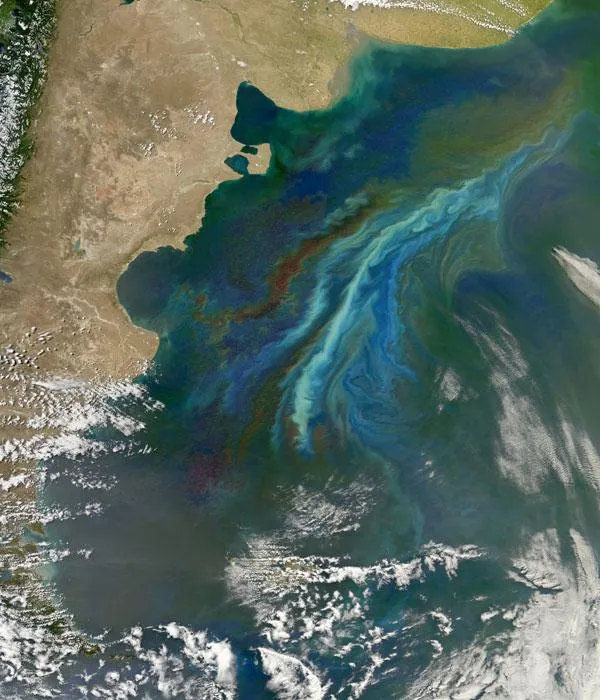
The world makes its own art every day, and this new image from NASA is a great example.
Off the coast of Argentina, two strong ocean currents recently stirred up a colorful brew of floating nutrients and microscopic plant life. NASA's Aqua satellite captured this image of the massive phytoplankton bloom off of the Atlantic coast of Patagonia on Dec. 21, 2010. It was released Dec. 31.
Scientists used seven separate different spectral bands to highlight the differences in the plankton communities across this swath of ocean. The milky green and blue bloom developed in an area known as the Brazil-Falklands Confluence. It's where the warm salty waters of the subtropical Brazil Current flow south and meet the colder, fresher waters brought north from the Southern Ocean by the Falklands (Malvinas) Current.
Where these currents collide along the continental shelfknown to oceanographers as a shelf-break frontturbulent eddies form and pull nutrients up from the deep ocean, NASA scientists explained. Also, the Rio de la Plata runs off the land and deposits nitrogen and iron-laden sediment into the ocean just north of the area shown in the image. Add in some strong summer sun, and you have a bountiful feast for the microscopic, floating plantsphytoplanktonthat form the center of the ocean food web. Those plants become food for everything from microscopic animals (zooplankton) to fish to whales.
Though it is impossible to say for sure without direct sampling of the water, most of the phytoplankton blooming in this photo are likely coccolithophores, single-celled plants that form calcite scales. Calcite is a carbonate mineral often found in limestone chalk. Blooms of coccolithophores are common in those waters in southern hemisphere's spring and summer. Diatoms might also be in the mix, the researchers said.
Get the world’s most fascinating discoveries delivered straight to your inbox.
