














New 'Pseudoscorpion' Discovered in Cave of Yosemite

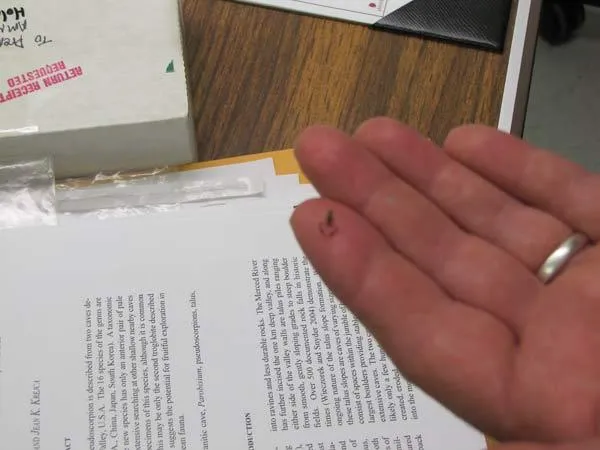
A teeny, tiny arachnid species has been discovered in the granite caves of Yosemite National Park.
The so-called pseudoscorpion has a venom-filled claw that is poised to strike at prey that wanders by in the darkness of the caves. Fortunately its small size -- it is less that half an inch (1.3 cm) in length -- means it isn't a threat to humans or anything larger than about one-eighth of an inch (0.3 cm).
This eensy predator is called the Yosemite cave pseudoscorpion (Parobisium yosemite). Pseudoscorpions are small arachnid predators that have eight legs, as all arachnids do, but they lack the tail-like stinger of true scorpions.
"This pseudoscorpion was originally found three or four years ago," said co-discoverer James C. Cokendolpher, a research scientist and assistant curator of invertebrates at The Museum of Texas Tech University. "There was a team from Austin that was hired to go into some of the caves in Yosemite National Park to do a survey and map some of the caves."
Team member Jean K. Krejca helped catch the arachnid in the caves; she sent two specimen to Cokendolpher for identification.
"Once we discovered it was a species unknown to science, they went back and collected in some other areas to see if the species was there," Cokendolpher said. The researchers described the new species in the Sept. 30 Occasional Papers by Texas Tech University's Natural Science Research Laboratories.
Finding the pseudoscorpion in the caves formed from granite rockfalls came as a surprise, Cokendolpher said, because most cave-dwelling species live in limestone caves, he said, where more humidity and access to food makes it more hospitable for life.
Get the world’s most fascinating discoveries delivered straight to your inbox.
It might be the second discovered cave-dwelling pseudoscorpion that lives in these granite talus caves in the world, he said.
{brightcove LS_101203_New-Arachnid}
The pseudoscorpion's dimuntive size is fairly typical of organisms that live in caves , Cokendolpher said. Most of the more than 3,000 species of pseudoscorpions are much smaller, he added.
Cokendolpher explained the animal doesn't move around much, probably to conserve energy.
"I kept a couple of them in the laboratory for quite a while," he said. "They basically sat and did nothing for much of the time."
Over the course of several weeks, the pseudoscorpions were given food, but only one tiny spider was eaten.
"Like many of other cave animals, it doesn't need a lot of nourishment. That's good for them in a food-poor environment," Cokendolpher said.
