














Remarkable Rock: The Great Dyke of Zimbabwe

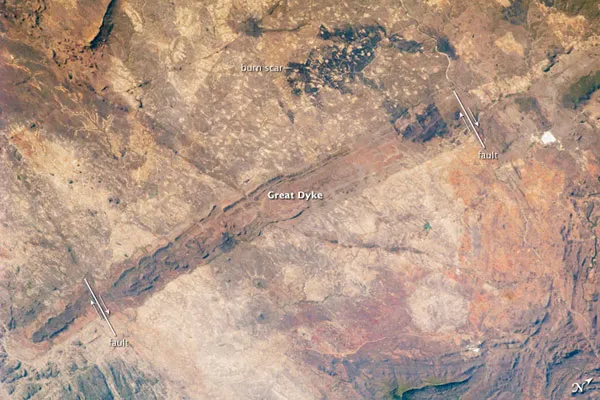
The Great Dyke of Zimbabwe is one of the most remarkable rock formations in the world.
The Great Dyke is an intrusion of 2.5-billion-year-old igneous rock into even older rocks of the Zimbabwe Craton, the core of oldest rocks forming the continent of Africa. Other cratons, such as the North American craton , also act as the core of modern-day continents.
Over the millennia, the various cratons were transported, twisted, folded, eroded and split by the tremendous geological forces continually reshaping Earth's surface .
Zimbabwe's Great Dyke, running vertically through the center of this image, probably formed slowly, over centuries, as molten rock forced its way up from the Earth's interior through the Zimbabwe Craton. In cross section, the Great Dyke looks somewhat triangular, suggesting to geologists that it rose along deep faults associated with extension of the African crust.
This geological feature stretches more than 342 miles (550 kilometers) northeast to southwest across the center of Zimbabwe, varying from 2 to 8 miles (3 to 12 km) in width.
Younger faults have offset sections of the Dyke along its length; two of the most obvious faults in the image are indicated, with arrows showing the relative directions of offset.
Layered mafic (a mineral or rock made up of magnesium and iron) intrusions, such as the Great Dyke are usually associated with economically important metals such as chromium, nickel, copper, platinum, titanium, iron, vanadium and tin. Chromium, in the form of the mineral chromite, and platinum are particularly abundant in the Great Dyke and actively mined to support Zimbabwe's economy.
Get the world’s most fascinating discoveries delivered straight to your inbox.
While the Great Dyke and its metal ores are products of geologic processes from the deep past, more recent events have also left their mark on the landscape. Two large burn scars from fires are visible at the top center of the image.
