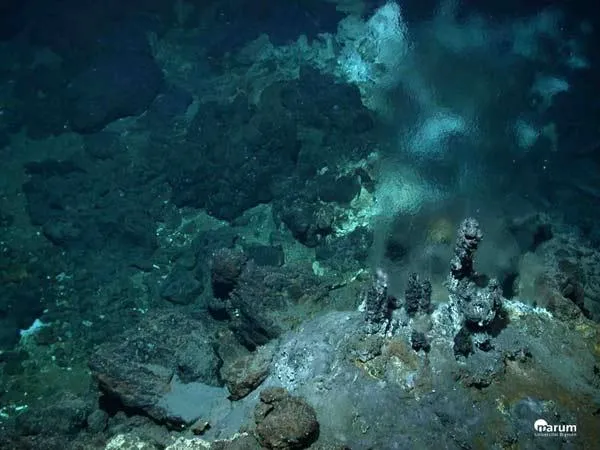
An area of hydrothermal vents has been discovered deep below the sea in the middle of the Atlantic Ocean.
The discovery of the vents, which lie nearly 10,000 feet (3,000 meters) below the ocean surface, was a surprise to scientists as the area in which they were found, about 300 miles (500 kilometers) southwest of the Azores, has been extensively studied in the past.
The hydrothermal vents feature chimney-like structures as high as 3 feet (1 m) that spew out fluids as hot as 572 degrees Fahrenheit (300 degrees Celsius).
Scientists from the MARUM Center for Marine Environmental Sciences and the Max Planck Institute for Marine Microbiology in Bremen on board the German research vessel Meteor found the vents by using an echosounder that allows the imaging of the water column above the ocean floor with more precision than previous instruments.
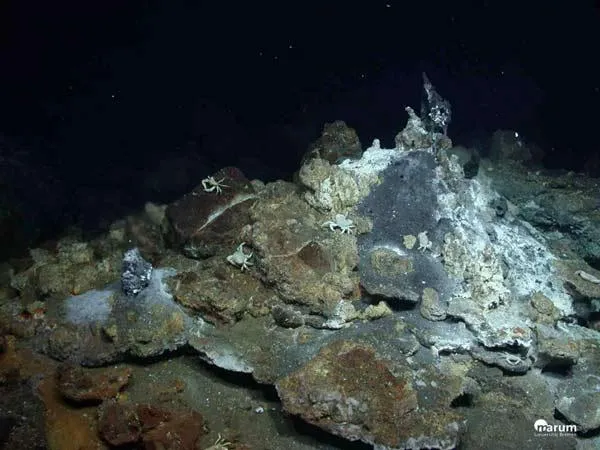
With the sounder, the scientists saw a plume of gas bubbles in the water column at a site about 3 miles (5 km) away from the known large vent field Menez Gwen that they were working on. A dive with the remote-controlled submarine MARUM-QUEST revealed the new hydrothermal site with smokers and animals typically found at vents on the Mid-Atlantic Ridge.
The hydrothermal vent crab Segonzacia on a mound that is covered with white bacteria and mineral precipitates.
(Image credit: MARUM)
Since the discovery of the new vent, the scientists have been intensively searching the water column with the echosounder. To their astonishment, they have already found at least five other sites with gas plumes. Some even lie outside the volcanically active spreading zone in areas where hydrothermal activity was previously not assumed to occur.
"Our results indicate that many more of these small active sites exist along the Mid-Atlantic Ridge than previously assumed," said Nicole Dubilier, the chief scientist of the expedition. "This could change our understanding of the contribution of hydrothermal activity to the thermal budget of the oceans."
Sign up for the Live Science daily newsletter now
Get the world’s most fascinating discoveries delivered straight to your inbox.
"Our discovery is also exciting because it could provide the answer to a long-standing mystery: We do not know how animals travel between the large hydrothermal vents, which are often separated by hundreds to thousands of kilometers from each other. They may be using these smaller sites as stepping stones for their dispersal," Dubilier said.
For the science geek in everyone, Live Science offers a fascinating window into the natural and technological world, delivering comprehensive and compelling news and analysis on everything from dinosaur discoveries, archaeological finds and amazing animals to health, innovation and wearable technology. We aim to empower and inspire our readers with the tools needed to understand the world and appreciate its everyday awe.