















Colorful Carpet of Cool Sea Creatures Discovered 2 Miles Deep
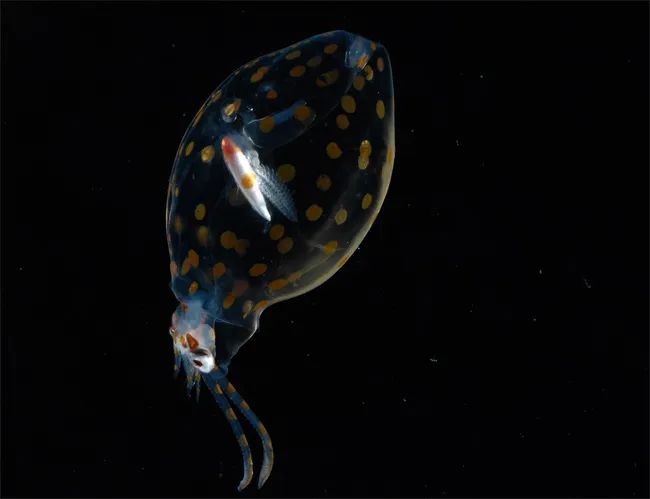
A submerged mountain ridge beneath the North Atlantic Ocean has revealed a new crustacean species and oodles of other life forms, ranging from polka-dotted glass squid resembling beach balls to grim viperfish with teeth like ice-picks.
The finds were made by a team of 31 scientists during a five-week expedition to explore life along the Mid-Atlantic Ridge using remotely operated vehicles equipped with digital cameras and other technologies.
The "underwater eyes" surveyed regions from a half-mile to 2 miles (800 to 3,500 meters) deep and revealed distinct habitats, with colorful carpets of sponges and corals covering the rocky cliffs, and starfish, brittle-stars, sea cucumbers and burrowing worms taking residence in the softer sediments. Above the ridge, fishes, crabs, squid and shrimps foraged for food.
On the western side of the underwater ridge, the scientists, led by Monty Priede of the University of Aberdeen in Scotland, discovered swarms of what could be a new species of Ostracod, or seed shrimp. The shrimp-like animal camouflages itself in the murky waters between depths of 164 and 656 feet (50 and 200 meters) with its see-through body.
As with the seed shrimp, the appearance and lifestyle of all the ridge's wonky creatures are a perfect fit for deep-sea life. The jewel squid, for instance, sports lopsided eyes to keep an eye out for predators (like the viperfish) both above and below.
“It is like surveying a new continent half way between America and Europe," Priede said. "We can recognize the creatures, but familiar ones are absent and unusual ones are common. We are finding species that are rare or unknown elsewhere in the world.”
The scientists still have extensive work to do studying the collected creatures along with physical data from the region.
Get the world’s most fascinating discoveries delivered straight to your inbox.
"The Mid-Atlantic Ridge is still relatively unexplored so this voyage will have played a vital role in expanding our knowledge of the biodiversity of the region," said Steve Wilson, director of science and innovation for the Natural Environment Research Council in Wiltshire, England, which funded the expedition.
- Top 10 Freaks of Nature
- Image Gallery: Under the Sea: Life in the Sanctuaries
- 10 Amazing Things You Didn't Know About Animals
Jeanna Bryner is managing editor of Scientific American. Previously she was editor in chief of Live Science and, prior to that, an editor at Scholastic's Science World magazine. Bryner has an English degree from Salisbury University, a master's degree in biogeochemistry and environmental sciences from the University of Maryland and a graduate science journalism degree from New York University. She has worked as a biologist in Florida, where she monitored wetlands and did field surveys for endangered species, including the gorgeous Florida Scrub Jay. She also received an ocean sciences journalism fellowship from the Woods Hole Oceanographic Institution. She is a firm believer that science is for everyone and that just about everything can be viewed through the lens of science.