This Research in Action article was provided to LiveScience in partnership with the National Science Foundation.
Astronomers have developed a new way to detect chemical processes that take place on extrasolar planets, a technique that could one day help us find distant planets capable of sustaining life.
The new approach refines earlier attempts to deduce the chemical composition of an extrasolar planet's atmosphere — or surface, if there is no cloud cover — by first separating the light from the planet from that of its host star with set of new complex imaging tools. Then the light is divided into a spectrum.
Latest Videos FromLive Science
The field of spectroscopy takes advantage of the fact that light waves reveal characteristic clues about their sources and the gases they have passed through. Applied to extrasolar planets, when light waves emanate from a warm orbiting planet, the light waves interact with the any molecules they hit — such as water or methane in the clouds of a gaseous planet. The light then re-emits into space, altered by the interaction.
Because chemicals absorb characteristic combinations of light wavelengths, they leave spectral "fingerprints," from which astronomers can deduce the chemicals present on even distant objects in the sky.
Such techniques are common for studying the chemistry of our own planet's atmosphere, or planets, asteroids and comets within our solar system.
However, light coming from distant solar systems is dominated by light from the host star, or stars, around which extrasolar planets orbit.
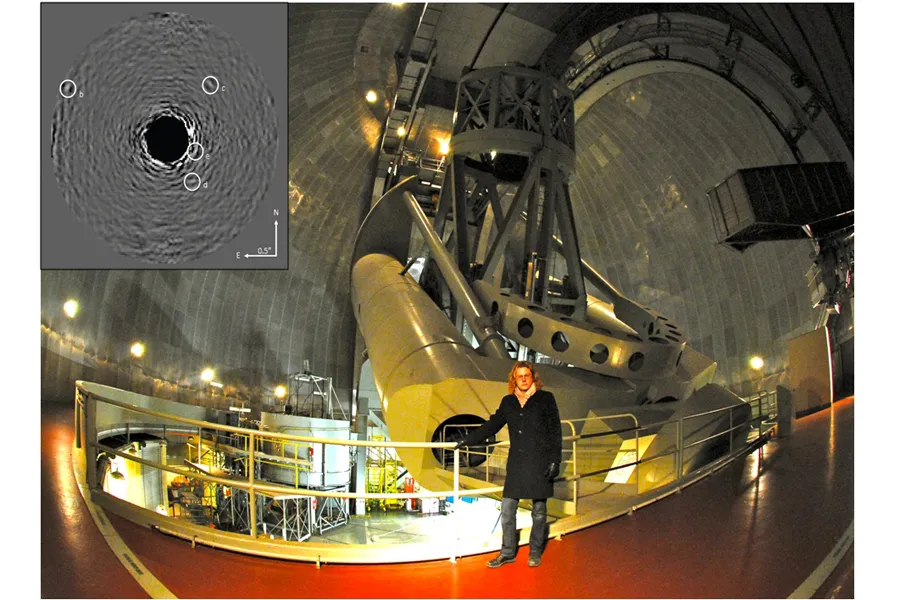
To get around that obstacle, researchers with the NSF-supported Project 1640, led by astronomer Ben Oppenheimer, associate curator at the American Museum of Natural History in New York, have developed a technique to block much of the light coming from a distant star while simultaneously isolating the light emitted by each of its orbiting planets — or, at least those planets that current telescopes can detect. The effort, supported by NSF, NASA and the Plymouth Hill Foundation, recently was accepted for publication in The Astrophysical Journal. Additional funding sources for Project 1640 are listed here.
"Through this effort, astronomers are now able to monitor cloudy skies on extrasolar planets, and for the first time, they have made such observations for four planets at once," says Maria Womack, a program officer at National Science Foundation who has helped fund the research. "This new ability enables astronomers to now make comparisons as they track atmospheres, and maybe even weather patterns, on the planets."
Using the new technique, Oppenheimer and his colleagues detected unexpected chemistry for four planets orbiting the star HR 8799, which lies 128 light years from Earth. If these initial findings hold firm, the data suggest that the planets, to varying degrees, have either some ammonia or some methane, an unusual finding since both chemicals are expected to be present together in planets that are of the same temperature (1340 degrees Fahrenheit) as those orbiting HR 8799. Additionally, the scientists may have detected acetylene, which no one had yet seen on an extrasolar planet.
Editor's Note: Any opinions, findings, and conclusions or recommendations expressed in this material are those of the author and do not necessarily reflect the views of the National Science Foundation. See the Research in Action archive.