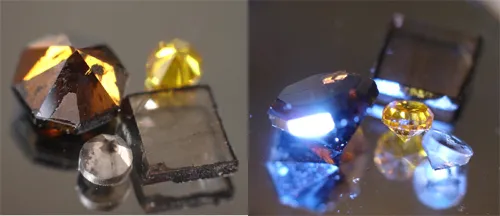
Researchers have developed a new technique for making very large diamonds of high quality that could soon boost optics technology and gaudily adorn fingers of the wealthy with sparkling rocks up to an inch wide.
Using a process called chemical vapor deposition (CVD), several groups have figured out how to make diamonds. But growing them over 3 carats has proved challenging.
"Our fabrication of 10-carat, half-inch, CVD diamonds is a major breakthrough," said Russell Hemley of the Carnegie Institution's Geophysical Laboratory. "We can make a 1/3 carat gems in one day."
The size is about five times what commercial diamond manufacturers can make using standard processes, Hemley and his colleagues said today.
In theory, the technique should be able to make diamonds an inch big, or roughly 300 carats.
The famed Hope Diamond is 45.52 carats.
Sign up for the Live Science daily newsletter now
Get the world’s most fascinating discoveries delivered straight to your inbox.
Natural diamonds, composed of carbon, are the hardest things known. They can be billions of years old, formed under intense pressure. Today, more diamonds are used in technology and industry than as adornment. They are superb for cutting and are even used in semiconductors.
Diamond is so hard it can be used to create pressure equal to the center of the Earth, a handy condition for testing theories of how substances react (hydrogen turns into a metal in such lab tests).
Natural diamonds can be clear or colored, depending on the presence of other materials in addition to carbon.
Synthetic diamonds are typically yellow or brown, limiting their use in optical technologies. Colorless diamonds -- a big goal for optics, scientific research and jewelry -- are expensive to make.
"Fundamentally there is no difference," Hemley told LiveScience. "Both have the same crystal structure. However, natural diamonds generally have many more defects."
The new process developed at Carnegie produces transparent diamonds, as well as some of striking color.
Hemley said the costs are low, but pricing at a jewelry store would depend on how synthetic gems are marketed.
For the science geek in everyone, Live Science offers a fascinating window into the natural and technological world, delivering comprehensive and compelling news and analysis on everything from dinosaur discoveries, archaeological finds and amazing animals to health, innovation and wearable technology. We aim to empower and inspire our readers with the tools needed to understand the world and appreciate its everyday awe.