
















Scientists Unveiling Exoplanet Discovery Wednesday: How to Watch Live

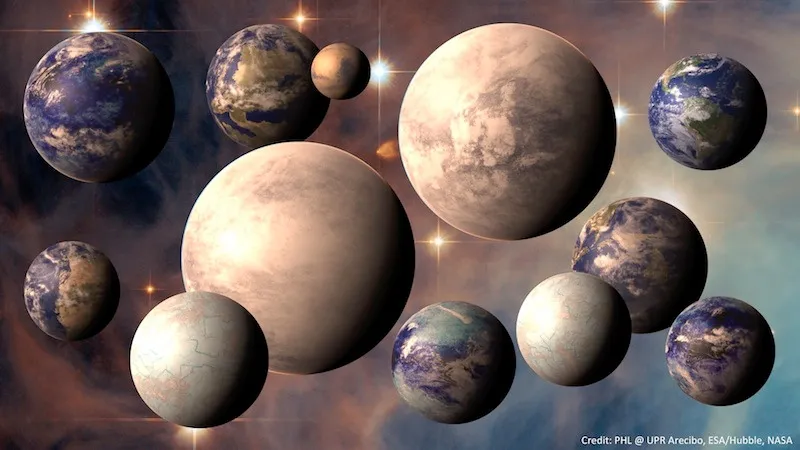
Scientists with the Harvard-Smithsonian Center for Astrophysics (CfA) will unveil the latest discovery in the search for Earth-like planet outside our own solar system on Wednesday (Feb. 6), and you can watch the announcement live online.
A press conference at the center will begin at 11 a.m. EST (1600 GMT) and be webcast online to unveil "new research on the prevalence of exoplanets orbiting red dwarf stars and the implications for the proximity of Earth-like worlds," CfA officials said in an announcement.
You can watch the announcement live online via the link here: http://www.cfa.harvard.edu/news/news_conferences.html
Wednesday's press conference will discuss research based on a study of data from NASA's prolific planet-hunting Kepler spacecraft. The scientists participating in the briefing will include:
- Courtney Dressing, graduate student at Harvard University
- David Charbonneau, professor of astronomy at Harvard University
- John Johnson, assistant professor of astronomy at Caltech
The Harvard-Smithsonian Center for Astrophysics is based in Cambridge, Mass., and combines the science resources of the Harvard College Observatory and the Smithsonian Astrophysical Observatory, according to a center description. About 300 scientists currently work together on joint projects at the center.
NASA's Kepler spacecraft has been seeking out new alien planets since its launch in 2009. The space telescope stares unblinking at a single part of the sky and records dips in starlight, an indication of a planet orbiting a faraway star.
To date, NASA's Kepler mission has found evidence of about 2,740 candidate alien planets, with 105 of those worlds confirmed by follow-up observations.
Get the world’s most fascinating discoveries delivered straight to your inbox.
Visit SPACE.com on Wednesday at 11 a.m. EST (1600 GMT) to see the exoplanet news from the Harvard-Smithsonian Center for Astrophysics.
This story was provided by SPACE.com, a sister site to Live Science. You can follow SPACE.com Managing Editor Tariq Malik on Twitter @tariqjmalik. Follow SPACE.com for the latest in space science and exploration news on Twitter @Spacedotcom and on Facebook.

Tariq is the editor-in-chief of Live Science's sister site Space.com. He joined the team in 2001 as a staff writer, and later editor, focusing on human spaceflight, exploration and space science. Before joining Space.com, Tariq was a staff reporter for The Los Angeles Times, covering education and city beats in La Habra, Fullerton and Huntington Beach. He is also an Eagle Scout (yes, he has the Space Exploration merit badge) and went to Space Camp four times. He has journalism degrees from the University of Southern California and New York University.