














World's Largest Land Crabs Tracked With GPS

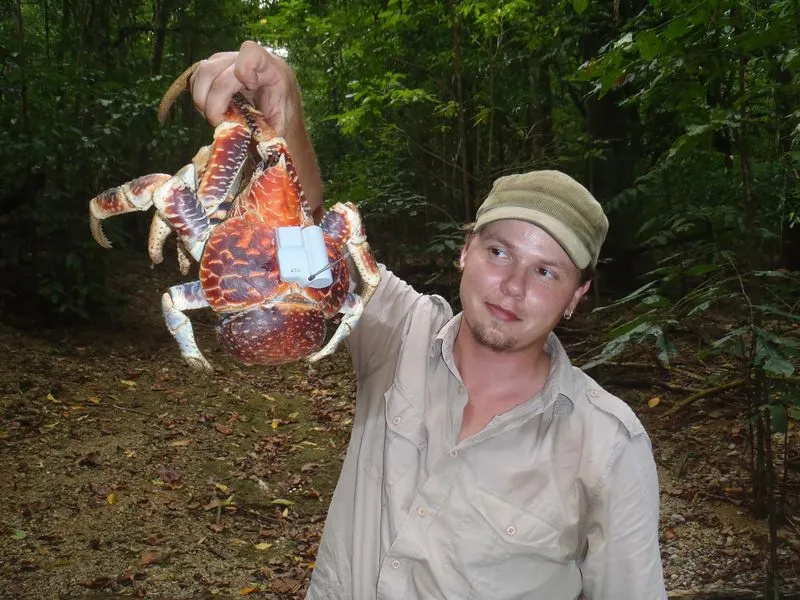
GPS technology has revolutionized the study of vertebrates like whales, birds and monkeys, allowing scientists to learn more about the animals' behaviors and sometimes-lengthy migrations. But nobody has used the technology to study arthropods, the world's most abundant animals, until now.
A study published this week in the journal PLoS ONE tracked 55 huge robber crabs on Christmas Island, south of Indonesia. The research found that these land crabs, which have a leg span of up to 3.3 feet (1 meter), typically stay within a small home range, living in crevices or between tree roots. Crabs are arthropods, an enormous group of animals defined by their exoskeletons; the group includes insects, arachnids and crustaceans.
The crabs can also travel more than two miles in search of water, food and mates, according to the new study. They mainly move between the island's inland rainforest and the coast. Males, previously thought to remain in the forest, were instead found to migrate toward the ocean as females do, possibly to drink the saltwater, which they prefer over freshwater.
The researchers also played a prank on the crabs, carrying them in an opaque bag up to 0.6 miles (1 kilometer) from their home territory. If released along their migratory route, the crabs could usually find their way home, the first demonstration of long-distance homing behavior in land crabs, according to the study. Released outside of this path, however, the crabs became lost, and never returned "home."
Also known as coconut crabs, these tropical monsters are the largest land-living arthropods on Earth, and can live up to 60 years. They may represent the upper limit to arthropod size. The crabs occur on islands throughout the Indian and Pacific Ocean, but are heavily hunted by humans, which has nearly eradicated them from much of their native range. It's currently unknown whether the crabs are at risk of extinction; the International Union for the Conservation of Nature lists them as "data deficient" and "rare."
Follow OurAmazingPlanet on Twitter @OAPlanet. We're also on Facebook and Google+.
Get the world’s most fascinating discoveries delivered straight to your inbox.
