













New Bridges Made of Bendable Concrete

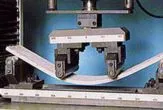
By mixing fiber in concrete scientists have created a bendable material that is lightweight, resists cracking, and lasts longer.
The newfangled concrete, already in use in Japan, Korea, Switzerland and Australia, will find its first application in the United States this summer, researchers said this week.
Fiber-reinforced concrete is not new. But this variety, developed at the University of Michigan, is said to be 500 times more resistant to cracking than what your sidewalk is made of. It's also 40 percent lighter.
Concrete is a mix of cement, water and sand or gravel. In bridges and buildings, it is typically reinforced with metal wire or bars.
The new mix contains mostly the same ingredients as regular concrete minus the coarse gravel, explained engineering Professor Victor Li. It looks like regular concrete, but under intense strain it gives instead of breaking because fibers slide within the cement. The fibers behave somewhat like your body's ligaments, holding things together in a flexible manner.
The stuff is called Engineered Cement Composites (ECC).
The Michigan Department of Transportation (MDOT) will use the ECC to replace part of a bridge that crosses Interstate 94. The slab will eliminate the need for expansion joints, which are moveable steel teeth that separate sections of regular concrete. With the ECC, a longer continuous slab will be possible.
Get the world’s most fascinating discoveries delivered straight to your inbox.
"The ECC material has promise for solving some of the deck durability issues we face, such as premature cracking," said Steve Kahl, a supervisor in MDOT's experimental studies group. "We're hoping the ECC will work well, and possibly lower the cost when experience is gained on large scale production."
The Mihara Bridge, a new structure in Hokkaido, Japan, has a deck of ECC that is a mere 2 inches (5 centimeters) thick. It is expected to open this month.
Studies suggest ECC should last twice as long as regular concrete, but the researchers said more tests are needed to confirm that claim. Li estimates that over the course of 60 years, with servicing and replacement costs considered, a bridge made of ECC could be cost 37 percent less than a traditional span.
A video of the material being bent is available here.
Related Stories
