














How Wave Shapes Could Explain Deadly Tsunamis

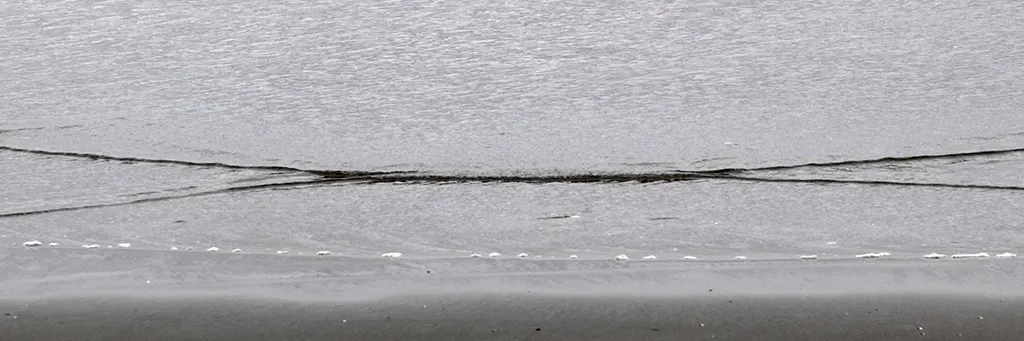
X- and Y-shaped ocean waves that are often seen at beaches may help explain why tsunamis can be so devastating, researchers say.
Ocean waves can sometimes interact to yield ripples that are much taller than the simply added combined heights of their originating waves, a sign of what researchers call "nonlinear interactions." (If they were linear, the wave heights would simply add together.) In shallow waters, most of these unusually tall waves look like an X or a Y from above, or like two connected Ys.
Scientists thought these waves were rare in nature. Now mathematicians Mark Ablowitz and Douglas Baldwin at the University of Colorado at Boulder find they are surprisingly common, happening all the time, and have developed model equations that describe them.
"Mark saw X- and Y-type interactions on a beach in Mexico," Baldwin recalled. "He was walking on the beach and thought he saw an X-type interaction, then he saw another and another and knew he'd really stumbled onto something." [The Surprisingly Strange Physics of Water]
"On a whim, I decided to drive to California with the hope of at least seeing one of the interactions that Mark had seen," Baldwin added. "My dream came true. After driving around for a few days looking for the right beach, a friend suggested Venice Beach and it was perfect."
X-amplified
The researchers saw these strange waves on two flat beaches about 1,200 miles (2,000 kilometers) apart on the Pacific coast. The researchers saw thousands of these waves from 2009 to 2012 every day within two hours before and after low tide on these beaches, where the water was less than about 8 inches (20 centimeters) deep. The X- and Y-shaped waves typically came in groups that lasted a few minutes.
Get the world’s most fascinating discoveries delivered straight to your inbox.
"I don't think there is anything more enjoyable in science than discovering something by chance, predicting something you haven't seen, and then actually seeing what you've predicted," Baldwin said.
The researchers suggest the way these unusual waves formed may also help explain the growth of destructive tsunamis. For instance, recent observations of the tsunami from the disastrous 2011 Japan earthquake revealed that it was the result of wave mergers that significantly amplified the tsunami and its destructive power. Near the junction of this merger, satellite photos revealed an X structure.
"Tsunamis are bad enough, but when an X forms, it is much larger, and due to nonlinear effects it can be much more than a factor of two [higher] in height," Ablowitz said.
Math in the real world
The link between the relatively small beach waves and the monster tsunamis is that the ratio of the waves to the respective water depth they are located in is small, the researchers said.
"Tsunamis can be devastating — the better we understand them, the better we can protect people from their destructive power," Baldwin added. "The equation that models our shallow ocean waves can also be used to model tsunamis."
Math was the reason the researchers looked for these waves, Ablowitz said. "It again shows that math is a critical subject in the study of real-world phenomena," he noted.
The scientists detailed their findings Sept. 6 in the journal Physical Review E.
This story was provided by OurAmazingPlanet, sister site to LiveScience.
