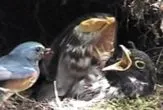
If birds could read, this tale of deceit and murder would shock the avian world.
A parasitic bird called the Horsfield's hawk-cuckoo lays an egg in the nest of another bird species, such as the bushrobin. That's just the beginning of the treachery. When the hawk-cuckoo chick is born, it pushes the bushrobin's natural offspring out of the nest.
And the newborn hawk-cuckoo has another trick up its sleeve or, rather, up its wing feathers.
Scientists have wondered how the parasitic chick gets fed, because other studies have shown that it takes the stimulation of multiple open beaks -- either the sight or the sound -- to compel a mother bushrobin to provide food.
The clue to the mystery is in bright yellow patches on the ends of the hawk-cuckoo's wings.
Japanese researchers found that the chicks make those patches quiver, and they mimic the mouths of other chicks. So the lone nestling gets fed.
The patches don't resemble open mouths all that much, the scientists say, but it seems the bushrobins can't tell the difference in a relatively dark nest. The researchers tested the idea by covering the yellow patches with black paint. When they did that, the parasitic chicks got less food.
Sign up for the Live Science daily newsletter now
Get the world’s most fascinating discoveries delivered straight to your inbox.
The study was done by Keita Tanaka and Keisuke Ueda of Rikkyo University in Tokyo and is detailed in the April 29 issue of the journal Science.
The hawk-cuckoo isn't the only parasitic bird. America's brown-headed cowbird is also a nest invader. But the cowbird joins its nestmates in a chirping chorus to bring in more food than it could on its own, according to a separate study announced last year.
Robert is an independent health and science journalist and writer based in Phoenix, Arizona. He is a former editor-in-chief of Live Science with over 20 years of experience as a reporter and editor. He has worked on websites such as Space.com and Tom's Guide, and is a contributor on Medium, covering how we age and how to optimize the mind and body through time. He has a journalism degree from Humboldt State University in California.