Huge Rodent Was Bigger than a Bull

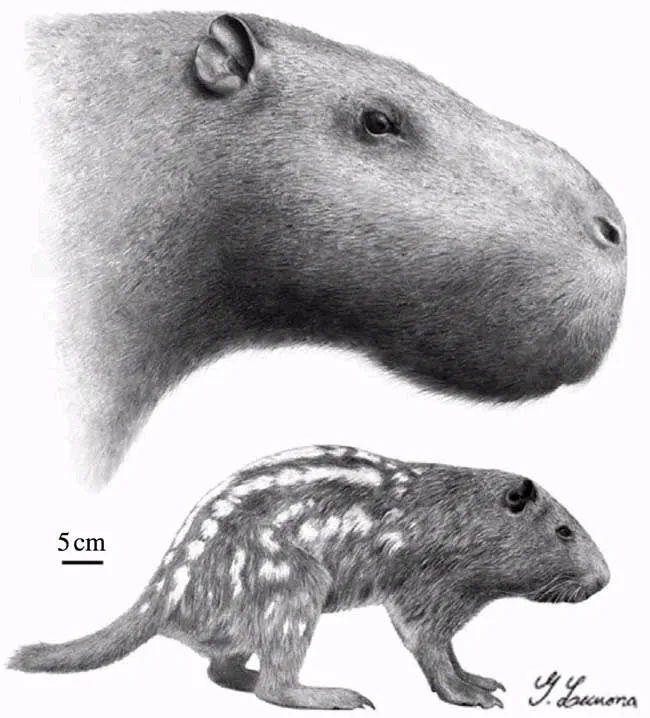
The largest rodent that ever lived weighed a ton or two, scientists revealed today.
The extinct mouse-like critter was larger than a bull.
An amateur paleontologist discovered the exceptionally well-preserved 20-inch-long fossil skull of the gargantuan rodent — dubbed Josephoartigasia monesi — embedded in a boulder on a beach in Uruguay. Scientists estimate this creature lived roughly 4 million years ago in South America, alongside terror birds, saber-toothed cats, giant sloths and massive armored mammals.
J. monesi weighed roughly 2,600 pounds on average, perhaps reaching up to 5,700 pounds.
Until this discovery, the largest known fossil rodent was Phoberomys, which might have weighed between 900 and 1,500 pounds when alive. In comparison, the largest rodent alive today — the capybara (Hydrochoerus hydrochaeris) of South America — weighs about 130 pounds.
"Imagine a mouse with the body weight of two race horses — it's very impressive indeed," researcher Ernesto Blanco, a biomechanicist at the Uruguayan Institute of Physics in Montevideo, told LiveScience.
The skull of the extinct rodent suggests it had weak chewing muscles, and its grinding teeth are very small. This suggests it might have eaten soft vegetation and perhaps fruit. Nearby fossils suggest it dwelled in forests in a river delta or near an estuary.
Get the world’s most fascinating discoveries delivered straight to your inbox.
Although the rodent's chewing muscles may not have been strong, the researchers hope to reconstruct its head muscles to see if it had a strong bite. "All rodents have powerful bites, but this giant one's probably was terrific!" Blanco said.
The scientists will detail their findings online Jan. 16 in the journal Proceedings of the Royal Society B.
- Video: Meet the Rat Man
- Vote: Freaks of Nature
- Image Gallery: The World's Biggest Beasts