













Inside Look at How Ice Melts
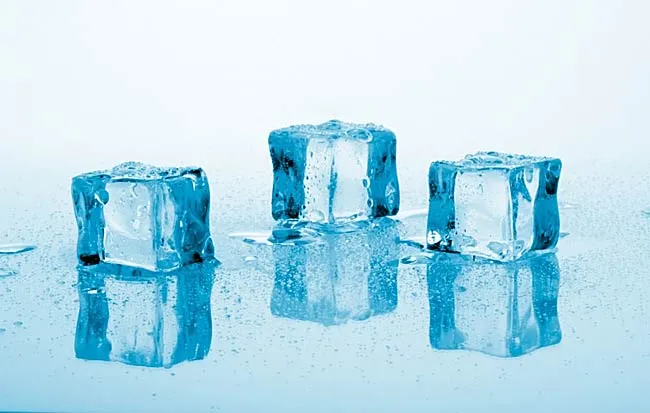
The science of melting ice just became a little more solid.
A new computer simulation shows that frozen water molecules, when heated up, vibrate until they start to spin. The swiveling motion causes the Mickey-Mouse-shaped particles to break free of their ice crystal home, bump into neighboring molecules and start a chain reaction of melting.
David van der Spoel, a computational chemist at Uppsala University in Sweden, said his team's computerized model is based on an actual 2006 experiment in which a laser melted ice, but could not provide the detail that the simulation offers.
"We want to see what’s happening on an atomic level … but experiments don’t show that detailed structure," van der Spoel told LiveScience. "We’ve done that here with computer simulations, added the picture of how something moves from solid to liquid on a realistic time scale."
That timescale is in fractions of picoseconds, which is less than one billionth of the time it takes for an eyelid to blink. Van der Spoel said studying melting ice may seen inane, but noted that detailed models of basic processes are crucial for life sciences, chemistry and materials science.
"My kids worry that what I'm doing is common sense, but the truth is that chemical companies, for example, always want the best models they can get," he said. "They can use them to tune chemical reactions and save a hell of a lot of money."
In the future, van der Spoel expects the real world to catch up with his team's simulation and verify the findings, detailed in the journal Angewandte Chemie (Applied Chemistry).
Get the world’s most fascinating discoveries delivered straight to your inbox.
- See the Video: How Ice Melts
- Video: Scientists Make Water Run Uphill
- The Craziest Science Stories of 2007