













What If the New Particle Isn't the Higgs Boson?

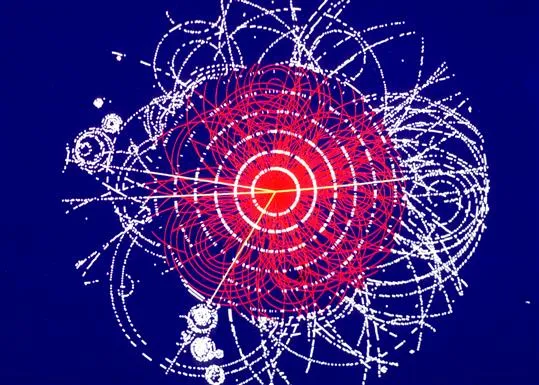
Physicists at the Large Hadron Collider (LHC) say they've discovered a new "Higgs-like" particle: a bundle of energy that has most of the trappings of the long-sought Higgs boson. They're not naming the newcomer outright, because there are subtle indications that the particle may not, in fact, be the plain old Higgs itself, but rather a close doppelganger.
Don't let that disappoint you. To the contrary, Harvey Newman, a high-energy physicist at the California Institute of Technology and a member of the Compact Muon Solenoid (CMS) experiment (one of two LHC experiments that discovered the new particle), said finding a more exotic variety of Higgs boson is actually "one of the most exciting things that can happen." Here's why.
The Higgs field, with its corresponding Higgs boson, was predicted to exist as the simplest explanation of why all the elementary particles in the universe have mass. In short, the Higgs field is a cosmos-size swimming pool, and everything is swimming in it. Particles that interact strongly with the Higgs field, "like a heavyset man swimming with his clothes on," in the words of John Gunion, a physicist at the University of California at Davis, are heavier than particles that breeze through the pool "like an Olympic swimmer in a wetsuit."
One Higgs swimming pool (and one corresponding Higgs boson — a sort of splash in the pool) is enough to impart mass to all the particles in the Standard Model: the standard theory describing the known elementary particles and the forces acting between them. But the Standard Model is not the whole story.
"It's simple and powerful, but we know it can't be the complete theory," Newman told Life's Little Mysteries. Believing in the Standard Model "would be like believing in Newton's laws of motion." The laws assume that space and time are separate and immutable entities. This is fine for describing the movements of slow and low-mass objects, but the laws break down for objects approaching the speed of light, or for black holes, which bend space and time. "Newton's laws are beautifully simple and describe so much, but we know it's not the fundamental theory, just the low-energy limit of a more fundamental theory" — that is, Einstein's theory of relativity, which seems to describe space-time exactly. "It's the same thing here. We know there must be a more fundamental theory than the Standard Model."
The Standard Model is incomplete, Newman said, because it doesn't account for the particles that make up 84 percent of the matter in the universe: the invisible substance known as dark matter. It also fails to incorporate gravity. Furthermore, the Standard Model treats matter and its oppositely-handed twin, antimatter, as if they are symmetrical, and so it doesn't account for why there is so much more matter than antimatter in the universe. And lastly, when you try to project the Standard Model to higher energies like those that existed in the early moments of the universe, "the theory essentially falls in on itself," Newman said.
The leading theory that places the Standard Model within a more powerful, all-encompassing framework is called supersymmetry, or SUSY. According to SUSY (which is incorporated into string theory), all the known particles have much heavier supersymmetric partners, known as sparticles. Not only does SUSY predict the existence of dark matter particles, it is also able to explain particle interactions at very high energies, like those just after the Big Bang. What's more, SUSY may account for nature's strange preference for matter over antimatter: It requires there to be at least five superimposed swimming pools in place throughout the universe, which could have a built-in asymmetry (like a giant counterclockwise whirlpool), giving rise to a surplus of matter. Those five swimming pools are Higgs fields, each with a Higgs-like boson. [The Funniest Theories in Physics]
Get the world’s most fascinating discoveries delivered straight to your inbox.
When generated in a particle collider like the LHC, each Higgs-like boson would be expected to decay into a unique set of lighter particles. It appears that the newfound particle at the LHC decayed in a way that the run-of-the-mill Standard Model Higgs would not have, the physicists said — although more data is needed before they'll know for certain what kind of Higgs they've got. But if the particle is, in fact, a more exotic Higgs, then it could be a SUSY Higgs, or at least a non-Standard Model Higgs. And this would be the first discovery of physics beyond the Standard Model.
"The Higgs sector particle not being the simplest Higgs boson would be the first indication that, yes, there is new physics out there. And that would provide tremendous momentum to the whole field," Gunion said, referring to the "sector" or group of possible Higgs particles.
Newman echoed the sentiment: "Overall, we have this tremendous view in front of us."
Follow Natalie Wolchover on Twitter @nattyover. Follow Life's Little Mysteries on Twitter @llmysteries. We're also on Facebook & Google+.

Natalie Wolchover was a staff writer for Live Science from 2010 to 2012 and is currently a senior physics writer and editor for Quanta Magazine. She holds a bachelor's degree in physics from Tufts University and has studied physics at the University of California, Berkeley. Along with the staff of Quanta, Wolchover won the 2022 Pulitzer Prize for explanatory writing for her work on the building of the James Webb Space Telescope. Her work has also appeared in the The Best American Science and Nature Writing and The Best Writing on Mathematics, Nature, The New Yorker and Popular Science. She was the 2016 winner of the Evert Clark/Seth Payne Award, an annual prize for young science journalists, as well as the winner of the 2017 Science Communication Award for the American Institute of Physics.