














Why We Are Drawn to Fire

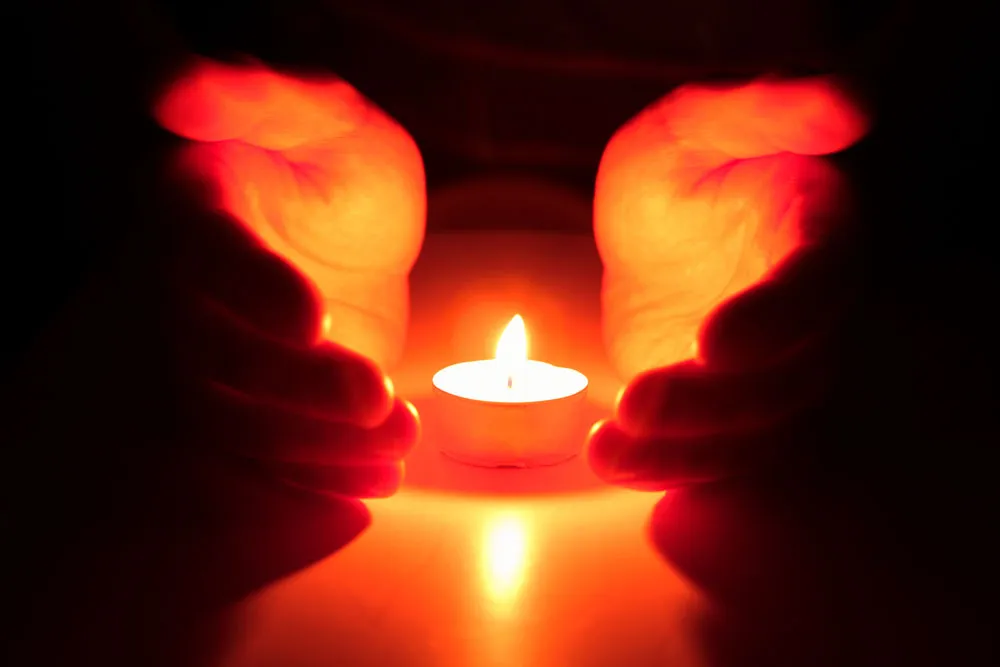
As America's $2 billion candle industry attests, there is something mesmerizing about a flickering flame. Most people love to feel fire's warmth, to test its limits, and to watch the way it consumes fuel. When there's a candle or bonfire around, why can't we help staring?
A dancing fire is pretty, as well as tantalizingly dangerous, but there may be a much deeper reason for our attraction to it. Daniel Fessler, an evolutionary anthropologist at the University of California, Los Angeles, has conducted research that indicates an adult's fascination with fire is a direct consequence of not having mastered it as a child. Fire has been crucial to human survival for around one million years, and in that time, Fessler argues, humans have evolved psychological mechanisms specifically dedicated to controlling it. But because most Westerners no longer learn how to start, maintain and use fire during childhood, we instead wind up with a curious attraction to it — a burning desire left to languish.
Related: Firewalking Physics: The Wrong Way to Walk on Hot Coals
"My preliminary findings indicate that humans arenot universally fascinated by fire," Fessler told Life's Little Mysteries. "On the contrary, this fascination is a consequence of inadequate experience with fire during development."
In societies where fire is traditionally used daily as a tool, Fessler has found that children are only interested by fire until such point as they attain mastery of it. After that point — usually at age 7 — people display little interest in fire and merely use it as one would use any ordinary tool. "Hence, the modern Western fascination with fire may reflect the unnatural prolongation into adulthood of a motivational system that normally serves to spur children to master an important skill during maturation," Fessler wrote in an email.
Unlike a spider that inherently knows how to weave a web, humans don't instinctively know how to produce and control fire. The ability must be learned during childhood. This may be because there was no universal method of fire building and control among our ancestors, who lived in diverse environments, and so there was no single method for evolution to ingrain in us. Instead, "fire learning" became the instinct. As Fessler put it in an article in the Journal of Cognition and Culture, "The only avenue open to selection processes operating on a species as wide-ranging as ourselves was to rely on learning for the acquisition of the requisite behaviors." [Top 10 Inventions that Changed the World]
Children are universally fascinated by predatory animals in a similar manner in which they are fascinated by fire. Because both could seriously harm or kill them, evolution requires that they be interested in those subjects, Fessler argues, as a way of ensuring that they pay special attention to information obtained about them. For example, children are naturally curious about which animals are dangerous and which aren't, as well as which materials are flammable and which aren't, and what the consequences are of adding, removing and rearranging objects in a fire. Our brains soak up this predator and fire knowledge.
Feed your curiosity with an exclusive mystery every week, solved with science and delivered direct to your inbox before it's seen anywhere else.
In the United States, children's natural inclination to learn about fire is evidenced by the hundreds of deaths that occur each year due to "fire play," or the deliberate setting of a fire for no purpose beyond the fire itself. A study by the psychiatrist David Kolko of the University of Pittsburgh found that about three-quarters of children set a play fire during the three-year window of the study (1999 – 2001). Prior studies found that curiosity was the primary motive for the behavior, which, fire department records show, peaks at age 12.
A 2002 study by Irene Pinsonneault of the Massachusetts Coalition for Juvenile Firesetter Intervention Program revealed children's most common questions about fire, and they're exactly the ones that would be expected to follow from an instinctual desire to learn how to build, control and use fire. The questions are: What makes fire hot? How does a small fire grow? Why are some fires very smoky? Can everything burn? How can you keep a fire small? How can you put fires out? [Easy Answers to the Top 5 Science Questions Kids Ask]
In societies in which fire is an everyday tool, kids learn these answers by age 7. Ethnographic data reveals that children in most such societies study adults' control of fire from infancy, and at age 3, start experimenting with fire (including building small fires and using them to "cook" pretend food, such as mud pies). They are gradually given more responsibility over the adults' fire as they grow older, and at age 7, are generally able to control fire. Fire play starts to wind down at that stage.
According to Fessler, here in the West, many or most of us never get to that point. "The motives that drive fire learning are only incompletely satisfied, with the result that, throughout life, fire retains greater allure or fascination than would normally be the case."
Follow Natalie Wolchover on Twitter @nattyover. Follow Life's Little Mysteries on Twitter @llmysteries and join us on Facebook.


Natalie Wolchover was a staff writer for Live Science from 2010 to 2012 and is currently a senior physics writer and editor for Quanta Magazine. She holds a bachelor's degree in physics from Tufts University and has studied physics at the University of California, Berkeley. Along with the staff of Quanta, Wolchover won the 2022 Pulitzer Prize for explanatory writing for her work on the building of the James Webb Space Telescope. Her work has also appeared in the The Best American Science and Nature Writing and The Best Writing on Mathematics, Nature, The New Yorker and Popular Science. She was the 2016 winner of the Evert Clark/Seth Payne Award, an annual prize for young science journalists, as well as the winner of the 2017 Science Communication Award for the American Institute of Physics.