















A Grass-Fed Evolution? Altered Environment Fueled Human Change

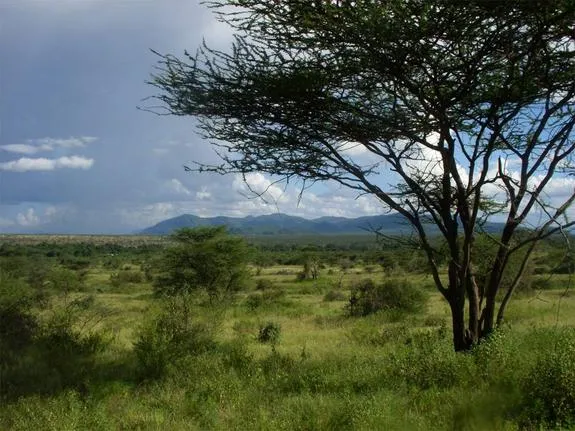
NEW YORK — The arrival of a new variety of plants, particularly grasses, may have altered the environment in ways that could have helped push our ancestors to acquire traits that would come to define modern humans.
Researchers have long pondered what prompted the emergence of upright posture, tool use, symbolic communication and enlarged brains. Some scientists point to changes in the environment, including a shift from forest to savanna in Africa, after humans' line split from that of chimpanzees, more than 6 million years ago.
The spread of the savanna grasses may have been a precondition for the evolution of the traits that characterize our genus, Homo, suggested Rowan Sage, of the University of Toronto, at a conference on human evolution and climate change at Lamont-Doherty Earth Observatory here in New York on Thursday (April 19). (Modern humans' full scientific name is Homo sapiens, meaning "wise man.")
The key — as it is to so much about life on Earth — is photosynthesis, Sage said. In photosynthesis, plants take in carbon dioxide from the atmosphere, and using water and energy from the sun, convert it to organic matter. In the process they produce oxygen, a component of the atmosphere and an element necessary for animal life.
After about 35 million years ago, an upgraded version of photosynthesis emerged, called the C4 pathway. And in time the plants that employed it, including grasses and sedges, spread. A declining level of carbon dioxide in the atmosphere appears to have been responsible for the switch to C4. Chemical evidence suggests the greenhouse gas declined over tens of millions of years. [10 Things That Make Humans Special]
C4 plants could use carbon dioxide more efficiently to feed themselves, and they used less water, making them well adapted to dry environments, like those favored during the Pliocene Epoch, which began about 5.3 million years ago, when grasslands and savannas spread.
As a potential source of food, the C4 plants weren't the best innovation. They offered tough, fibrous leaves, small-seeded grains and small, fibrous rhizomes. Even today, only a few dozen C4 plants, most significantly maize and sugar cane, are cultivated for food.
Get the world’s most fascinating discoveries delivered straight to your inbox.
But some other animals were better adapted to digesting these plants. Ruminants, such as cows and buffalo, regurgitate and re-chew a tough meal, Sage said.
"So the possibility is human evolution was driven by our ancestors going out and taking down the (animals) who could digest the C4 vegetation. But they would have to deal with these guys," he said, referring to a photo of a lion during his presentation.
So, given the option of eating the C4-eaters and the need to avoid predators, early humans may have evolved an upright stature, begun running long distances, carrying out extended hunts in groups and defending against predators, and evolved other distinctly human traits, he said.
By putting more carbon dioxide into the atmosphere by burning fossil fuels and other activities, modern humans may be shifting the balance between C4 and C3 plants, according to Sage. At close to 300 parts per million near 1900, carbon dioxide concentrations have risen to 390 ppm, and there is some evidence grasslands are filling in with woody C3 plants, he said.
You can follow LiveScience senior writer Wynne Parry on Twitter @Wynne_Parry. Follow LiveScience for the latest in science news and discoveries on Twitter @livescience and on Facebook.
