













Radar Device to Spot Enemies Through Walls
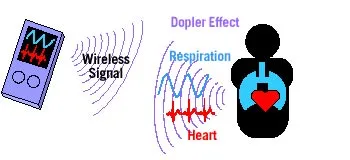
LifeReader, a wireless radar technology developed by Kai Sensor, has been given a first phase contract worth $850,000 by the U.S. Army. The intent is to develop military applications for the device, which can effectively "see through" walls to find people inside.
LifeReader is able to accurately detect and monitor heart and respiration activity of multiple subjects wirelessly, with no contact to the subjects (see diagram). It uses MIMO Doppler radar technology in combination with computer analysis.
The device was developed at the University of Hawaii's electrical engineering department.
Science fiction readers are long familiar with the idea of a LifeReader, if not the particular technology used to implement it. In his 1958 story Cease Fire, writer Frank Herbert introduced the idea of a "life detector," a special sensor technology that could be used by the military:
The antennae of the Life Detector atop the OP swept back and forth in a rhythmic halfcircle like so many frozen sticks brittle with rime ice... One operator - drugged to shivering wakefulness - stood watch in the OP. The space around him was barely six feet in diameter, crammed with equipment, gridded screens glowing a pale green with spots that indicated living flesh: a covey of ptermigan, a possible Artic fox... (Read more about Frank Herbert's life detector)
This device should be more accurate, and more specific, than the Radar Scope created by DARPA for troops in Iraq. The Radar Scope can also sense respiration, but cannot count heart rhythms or distinguish individuals.
Army strategists should take note: Herbert also imagined that, if there was a life detector, there might also be a life detector shield.
Planetary science engineers have also been busy in this area (perhaps mindful of the utility of having a sensor capable of detecting "life readings," ala classic 1960's Star Trek.) Find details in these articles:
Get the world’s most fascinating discoveries delivered straight to your inbox.
- Life Detector Robot To Find Life On Distant Worlds A robotic rover called Zoe is the first robot to remotely detect the presence of life.
- Urey Life Detector The Urey Mars Organic Oxidant Detector has been designed by NASA-funded researchers to look for life on Mars.
Via Star Bulletin; thanks to Mark Thompson for writing in with the story tip.
(This Science Fiction in the News story used with permission of Technovelgy.com - where science meets fiction
- What is the Doppler Effect?
- Military Mulls Use of 'Star Treek' Weapons
- Military Plans Cyborg Sharks