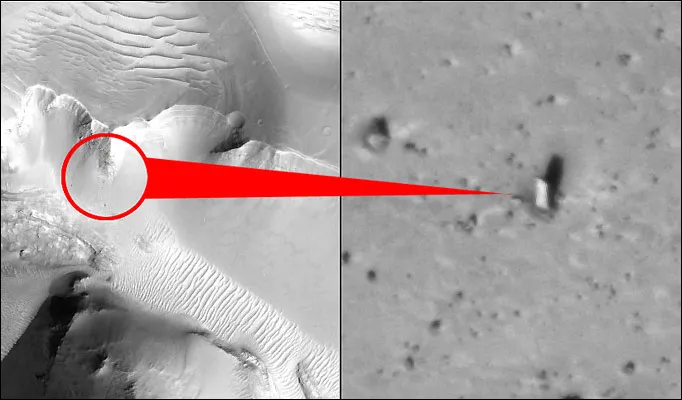
Amateur stargazers have discovered an intriguing object jutting out from the surface of Mars. The seemingly perfectly rectangular, upright structure, found in NASA images of the Red Planet, bears a striking resemblance to the monoliths planted on Earth and the moon by aliens in the classic sci-fi film "2001: A Space Odyssey."
The object in question was first spotted several years ago after being photographed by the HiRISE camera onboard the Mars Reconnaissance Orbiter, a NASA space probe; every so often, it garners renewed interest on the Internet. But is it unnatural — a beacon erected by aliens for mysterious reasons, and even more mysteriously paralleled in the imaginations of Stanley Kubrick and Arthur C. Clarke, creators of "2001"? Or is this rock the work of nature? [Photo]
According to Jonathon Hill, a research technician and mission planner at the Mars Space Flight Facility at Arizona State University, who processes many of the images taken during NASA's Mars missions, the object in question is no more than a roughly rectangular boulder.
The HiRISE camera that photographed it has a resolution of approximately 1 foot (30 centimeters) per pixel — impressive considering the 180-mile (300-kilometer) altitude from which it photographs the Martian surface, but not quite sharp enough to capture the cragginess of a mid-size boulder. "When your resolution is too low to fully resolve an object, it tends to look rectangular because the pixels in the image are squares. Any curve will look like a series of straight lines if you reduce your resolution enough," Hill told Life's Little Mysteries.
A monolith placed on Earth by aliens in "2001: A Space Odyssey."
(Image credit: Metro-Goldwyn-Meyer (MGM) via YouTube coldshouldermulder)
The location of the boulder at the bottom of a cliff near many other boulders suggests it broke off the cliff and tumbled to its current spot sometime in the distant past, Hill said. Such a perilous location is itself an argument against deliberate placement by aliens: "If I was going to build a monolith somewhere, that's the last place I would put it!" he said. "The debris falling from the cliff would cover it up pretty quickly, on geologic timescales." [Photos: Mysterious Stone Structures]
Hill added that the height of the boulder is being exaggerated in the photo by a low sun angle. Photographed when the sun was near the horizon, the boulder casts an especially long shadow.
The ufologists aren't necessarily wrong in calling it a monolith — the word simply translates from Latin as "one stone." But this monolith isn't the masonry of Martians.
Sign up for the Live Science daily newsletter now
Get the world’s most fascinating discoveries delivered straight to your inbox.
Follow Natalie Wolchover on Twitter @nattyover. Follow Life's Little Mysteries on Twitter @llmysteries and join us on Facebook.
Natalie Wolchover was a staff writer for Live Science from 2010 to 2012 and is currently a senior physics writer and editor for Quanta Magazine. She holds a bachelor's degree in physics from Tufts University and has studied physics at the University of California, Berkeley. Along with the staff of Quanta, Wolchover won the 2022 Pulitzer Prize for explanatory writing for her work on the building of the James Webb Space Telescope. Her work has also appeared in the The Best American Science and Nature Writing and The Best Writing on Mathematics, Nature, The New Yorker and Popular Science. She was the 2016 winner of the Evert Clark/Seth Payne Award, an annual prize for young science journalists, as well as the winner of the 2017 Science Communication Award for the American Institute of Physics.