













Sick Ants Help Vaccinate Colonies, Study Suggests

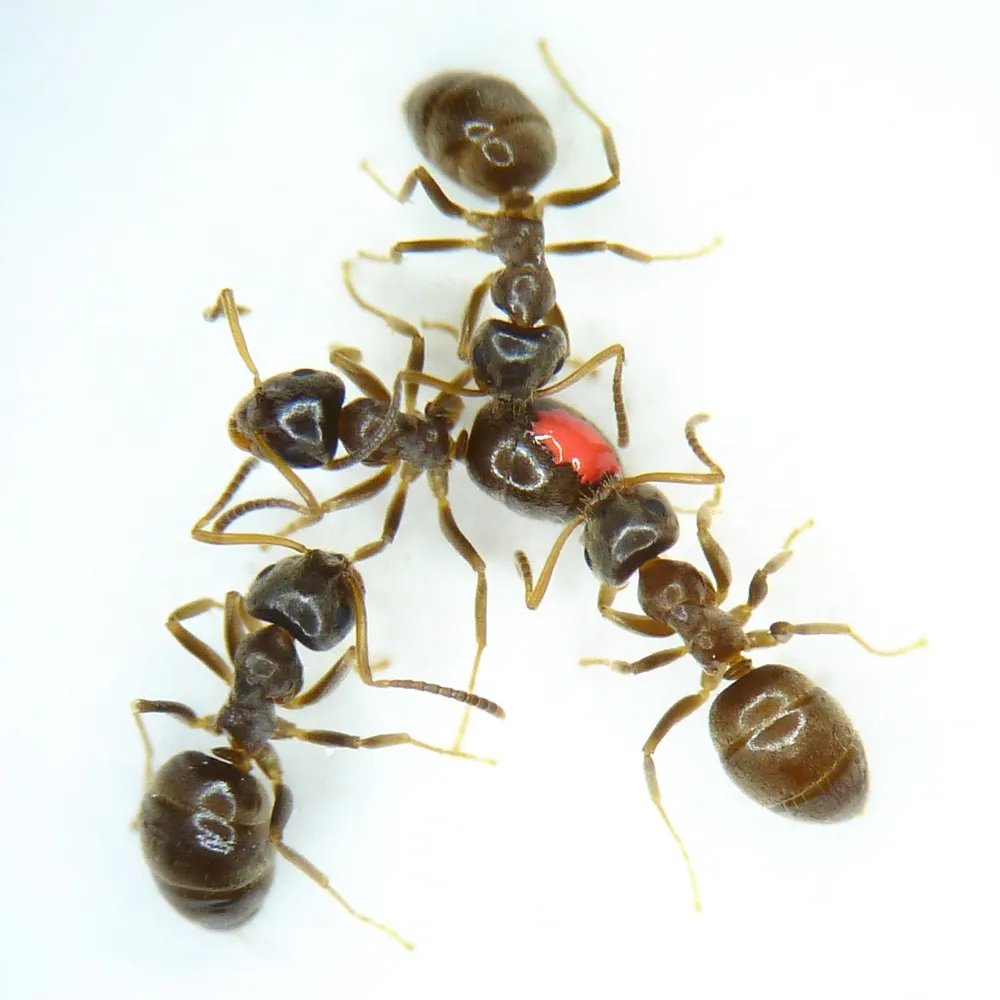
Like crowded megacities, busy ant colonies face a high risk of disease outbreaks. New research indicates such "urban ants" also know how to prevent epidemics — when an infected ant enters the colony, its nest mates carefully lick off the infecting fungus.
"This is increasing the survival of the originally exposed individual," study researcher Sylvia Cremer, of the Institute of Science and Technology Austria, told LiveScience.
And it turns out, the licking behavior may also help the doer by giving that individual greater immunity to the infecting fungus. Insects don't have the "adaptive" immune system that mammals do, but they are still able to fine-tune their disease-fighting systems to react to specific threats.
Fluorescent fungus
In nature, ants would pick up a fungal or other infection likely during foraging when they scamper across a cadaver of an infected ant or grasshopper, for instance, Cremer said.
To figure out how Lasius neglectus ants would react to such a diseased nest mate, the researchers infected one individual ant with fluorescent-labeled spores of fungus and let them interact with other members of their colony, tracking where the fluorescent spores ended up.
The researchers found that when this infected ant returned to the colony, its nest mates don't avoid it. Instead of running from the infected and contagious insect, the ants approached their colony mate and licked it, seemingto remove pathogens from the sick ant's body, a social grooming behavior.
Get the world’s most fascinating discoveries delivered straight to your inbox.
The originally infected ant had less of a chance of dying once its nest mates remove the spores, the researchers saw. This licking behavior exposes the healthy ants to a very small amount of the fungus, which was enough to be detected by tests the scientists ran. However, the small amount of fungus didn't make those licking ants sick.
The researchers saw that during this low-level infection, a set of immune genes related to anti-fungal defenses was activated in the ants. Lab tests then revealed that when later exposed to this fungus, these ants were better able to fight it off.
Herd immunity
The researchers made a computer model using data from their experiments and discovered that this licking behavior, while it kills a low number of ants, would enable a colony as a whole to recover from a fungal infection more quickly.
The licking behavior is similar to the human concept of a vaccine, which exposes people to a weakened or dead strain of virus to prime their immune system. Humans didn't discover protective immunity until Edward Jenner created the smallpox vaccine in 1796.
These types of interventions work best when the whole population is treated, giving rise to "herd immunity," in which even nonimmunized individuals aren't at risk of the disease because they are surrounded by immune individuals.
The study was published today (April 3) in the journal PLoS Biology.
You can follow LiveScience staff writer Jennifer Welsh on Twitter @microbelover. Follow LiveScience for the latest in science news and discoveries on Twitter @livescience and on Facebook.

Jennifer Welsh is a Connecticut-based science writer and editor and a regular contributor to Live Science. She also has several years of bench work in cancer research and anti-viral drug discovery under her belt. She has previously written for Science News, VerywellHealth, The Scientist, Discover Magazine, WIRED Science, and Business Insider.