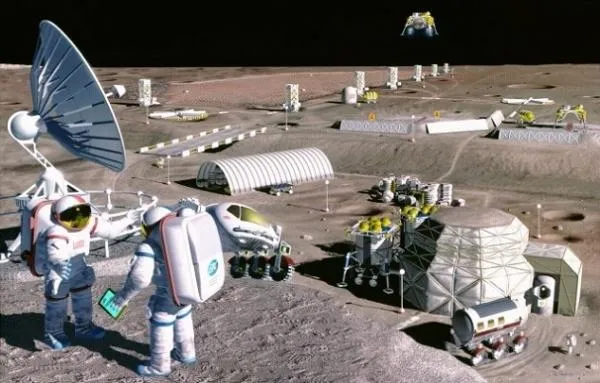
The United States will have a permanent manned colony on the moon by 2020 if Newt Gingrich is in charge, the Republican presidential hopeful announced today (Jan. 25).
Gingrich laid out this goal during a speech in the city of Cocoa, on Florida's Space Coast. He also said that near-Earth space would be bustling with commercial activity by 2020, and that America would possess a next-generation propulsion system by then, allowing the nation to get astronauts to Mars quickly and efficiently.
"By the end of my second term, we will have the first permanent base on the moon, and it will be American," Gingrich said.
The former Speaker of the House made no apologies for the boldness of his amibitions, which depend primarily on the emergence of a vibrant commercial spaceflight industry. He said the U.S. space program needs a kick in the pants like the one President John F. Kennedy gave it in 1961, when he promised to put a man on the moon by the end of the decade.
"I am sick of being told we have to be timid, and I am sick of being told we have to be limited to technologies that are 50 years old," Gingrich told a standing-room-only crowd of cheering supporters. [50 Years of Presidential Space Visions]
Bold plans
Gingrich claimed his big ideas would improve the country's current standing in space, which he views as unacceptable.
Sign up for the Live Science daily newsletter now
Get the world’s most fascinating discoveries delivered straight to your inbox.
With the retirement of NASA's space shuttle program last July, the U.S. is now reliant on Russia to get its astronauts to and from the International Space Station, and will be until 2017 or so, when private American vehicles may start coming online.
Meanwhile, China is ramping up its space program. It plans to build a manned space station in Earth orbit by 2020, and hopes to put a person on the moon sometime after that.
Bold space plans would help get America back on track in the short term, Gingrich said, and facilitate further success over the long term by helping inspire young people to study science, engineering and math.
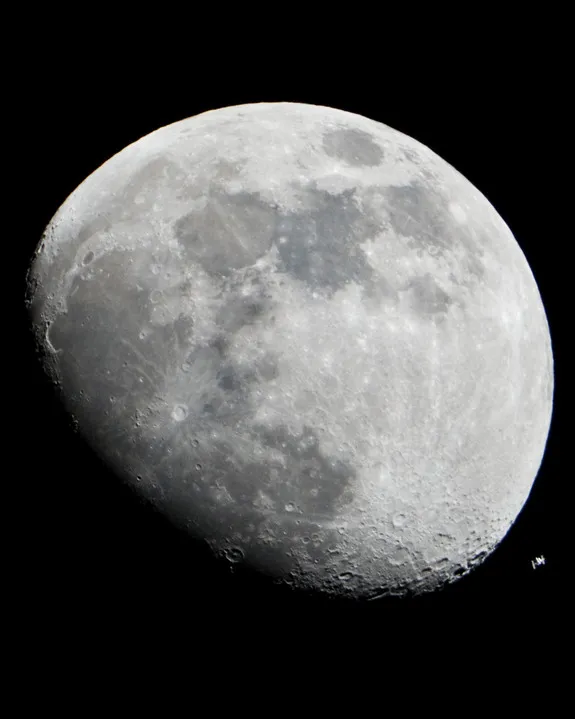
The International Space Station can be seen as a small object in lower right of this image of the moon in the early evening Jan. 4 in the skies over the Houston area flying at an altitude of 390.8 kilometers (242.8 miles).
(Image credit: NASA)
Are they feasible?
Gingrich's chief rival for the Republican nomination, former Massachusetts governor Mitt Romney, has occasionally called attention to the "grandiosity" of Gingrich's ideas about space and other subjects.
Gingrich said he doesn't view "grandiose" as an insult.
"I accept the charge that I am an American, and Americans are instinctively grandiose, because we believe in a bigger future."
But Gingrich's big plans may indeed be grandiose in the more traditional, pejorative sense, some experts say.
"When we are not expecting a U.S. crewed launch to the ISS until 2016-2017 and are just getting started on a lunar-class launch vehicle, establishing a lunar outpost by 2020 is a fantasy," space policy expert John Logsdon, professor emeritus at George Washington University, told SPACE.com via email. "It would be much better to set realistic goals, but that is not Mr. Gingrich's strong suit."
Gingrich proposed to help spur spaceflight action by setting up a system of prizes. He would establish a $10 billion prize, for example, for the first company or entity to get astronauts to Mars. Such a system would foster rapid development of commercial spaceflight capabilities akin to the strides made by the aviation industry in the 1920s and 1930s, he said.
In Gingrich's vision, these private enterprises — not NASA — would lead and enable humanity's expansion to the moon and Mars.
The former House speaker also implied that he would cut NASA's budget, stressing several times that he wants the space agency to be "leaner" and less bureaucratic. He added that he would allocate 10 percent of NASA's budget to help fund the prizes he's proposing.
This article was provided by SPACE.com, a sister site to LiveScience. SPACE.com staff writer Denise Chow (@denisechow) contributed to this story. You can follow SPACE.com senior writer Mike Wall on Twitter: @michaeldwall. Follow SPACE.com for the latest in space science and exploration news on Twitter @Spacedotcom and on Facebook.
Michael was a science writer for the Idaho National Laboratory and has been an intern at Wired.com, The Salinas Californian newspaper, and the SLAC National Accelerator Laboratory. He has also worked as a herpetologist and wildlife biologist. He has a Ph.D. in evolutionary biology from the University of Sydney, Australia, a bachelor's degree from the University of Arizona, and a graduate certificate in science writing from the University of California, Santa Cruz.