













Fast-Evolving Fish Struggle to Spawn in Wild

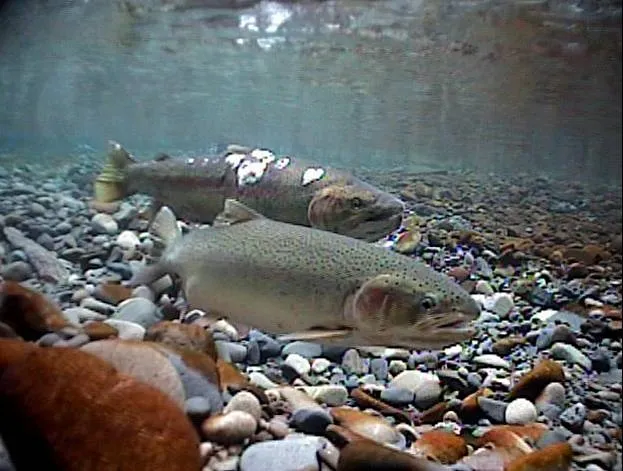
Salmon born in captivity become domesticated in as little as one generation, a new study finds, explaining why hatchery-born fish don't do as well as wild-born ones in Oregon rivers.
Researchers created an enormous fish family tree using genetic samples from 12,700 steelhead trout (which are in the same family as salmon) returning from the sea to Oregon's Hood River to spawn. This fishy pedigree revealed the fish that spawned well in hatcheries had offspring that spawned poorly in the wild.
"They're adapting to captivity in a single generation," study scientist Mark Christie, a postdoctoral researcher at Oregon State University, told LiveScience. In other words, the fish rapidly became domesticated, Christie and his colleagues reported yesterday (Dec. 19) in the journal Proceedings of the National Academy of Sciences.
"It's similar to the process by which wolves were transformed into dogs," Christie said. "That's all that's occurring here, except it's occurring at a really rapid time scale."
Saving salmon
Salmon are considered anadromous fish, meaning they hatch in freshwater streams and rivers, travel as juveniles to the oceans, where they mature into adults and return to their birthplace to spawn and die. Steelhead are actually an anadromous type of rainbow trout, part of the salmon family.
To increase threatened salmon populations in the Pacific Northwest, wildlife managers release more than 6 billion hatchery-born fish each year. But these fish reproduced at about 80 percent the rate of their wild-born brethren, Christie said, raising fears that the influx of hatchery salmon might affect the gene pool and harm the population as a whole.
Get the world’s most fascinating discoveries delivered straight to your inbox.
To understand the problem, Christie and his colleagues needed to find out why these hatchery-born fish lag behind on the reproductive front. Fortunately for their research, high dams block spawning fish from making it upstream in the Hood River on their own. As a result, the fish must be "passed over" the dam in what is essentially an aquatic elevator. This gives Oregon Department of Fish and Wildlife officials an opportunity to get a DNA sample from every fish that returns from the sea to spawn. [Photos: Deep-Sea Fish]
Using these DNA samples, Christie and his co-researchers traced the family relationships of 19 years of threatened Oregon steelhead (Oncorhynchus mykis), which unlike most salmon can survive multiple years of spawning. They found when fish produced higher-than-average numbers of offspring in the hatchery, the offspring of those offspring had just 71 percent the number of babies as fish born in the wild. In other words, whatever it is that makes baby fish thrive and survive in the hatchery is not beneficial in the real world.
Rapid adaption
The researchers also found that when hatchery-born fish were used to breed new generations in the hatchery, they produced more offspring than wild-born fish breeding in captivity. The two results together mean that the hatchery environment is putting strong evolutionary pressure on the fish, causing them to adapt rapidly — and to lose the strengths that help them in the wild.
"It's probably not just a single trait that is being selected upon," Christie said. "It's probably a lot of traits. When you sum up across all those traits you can get a rapid reduction in fitness."
The researchers aren't yet sure what specific genetic changes occur in hatchery-born fish that make them ill-suited for reproduction in the wild. One possibility, Christie said, is that hatchery fish grow quickly and head out to sea after one year of life. Wild fish are slower to develop, and spend several years in fresh water before heading to the ocean.
The researchers are now digging deeper into the fish genomes to uncover the differences between wild- and hatchery-born steelhead DNA.
"Now that we know what is causing this, we can focus on figuring out specifically what in the hatchery is going on," Christie said. "Once we get there, we'll be able to make more informed management decisions."
You can follow LiveScience senior writer Stephanie Pappas on Twitter @sipappas. Follow LiveScience for the latest in science news and discoveries on Twitter @livescience and on Facebook.

Stephanie Pappas is a contributing writer for Live Science, covering topics ranging from geoscience to archaeology to the human brain and behavior. She was previously a senior writer for Live Science but is now a freelancer based in Denver, Colorado, and regularly contributes to Scientific American and The Monitor, the monthly magazine of the American Psychological Association. Stephanie received a bachelor's degree in psychology from the University of South Carolina and a graduate certificate in science communication from the University of California, Santa Cruz.