













Evolution of Genitals: Shape Matters More Than Size

As far as evolution is concerned, genital size doesn't matter — but shape does.
Genitalia are important in the evolution of new species, since compatible parts are necessary for two individuals to successfully mate. Now, new research shows that as two species diverge, evolution acts on the shape and fit of genitalia first, leaving size issues for later.
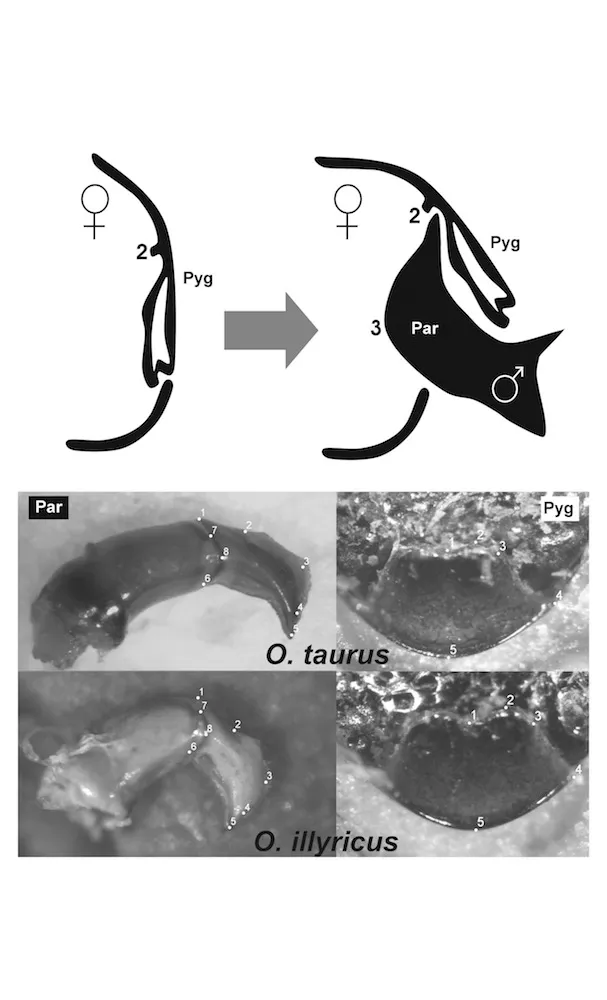
Using data from scarab beetle populations separated by anywhere from 50 years to millions of years, research led by scientists at Indiana University reveals that both male and female genitalia evolve rapidly and in parallel with one another. But between newly evolving species, genitals diverged faster in shape than they did in size.
"Parallel evolutionary divergence in male and female genitalia was something scientists long suspected or assumed, but we've had little or no data to support this assumption," said study researcher Armin Moczek, a biology professor at Indiana University, Bloomington. "But to see that this parallel divergence is so much faster for genital shape than size is a big surprise."
Strikingly, even beetle populations isolated from one another for a mere 50 years show large leaps in genitalia evolution, meaning the emergence of new species, unable to mate with one another (due to mismatched genitals), could happen faster than previously expected, Moczek said.
The researchers examined the female genital tract and the male copulatory organs of five different species of Onthopagus beetles from around the world. The most recently isolated groups were three populations in the Eastern United States, Western Australia and Eastern Australia, all of which had been taken from the Mediterranean and reintroduced by humans to far-flung habitats in the 1970s.
The researchers focused on male and female parts that interact physically during copulation — the female pygidium, a moveable plate that provides grooves and pits that serve as anchor points for the correct positioning of male genitalia, and the male parameres, which include projections that fit into those grooves and pits.
Get the world’s most fascinating discoveries delivered straight to your inbox.
They found that the size and shape of these organs evolves in diverging populations, but that the two factors evolve separately. Female and male organs that fit together like puzzle pieces evolved into new shapes simultaneously, the researchers reported online Dec. 14 in the journal PLoS ONE.
You can follow LiveScience senior writer Stephanie Pappas on Twitter @sipappas. Follow LiveScience for the latest in science news and discoveries on Twitter @livescience and on Facebook.

Stephanie Pappas is a contributing writer for Live Science, covering topics ranging from geoscience to archaeology to the human brain and behavior. She was previously a senior writer for Live Science but is now a freelancer based in Denver, Colorado, and regularly contributes to Scientific American and The Monitor, the monthly magazine of the American Psychological Association. Stephanie received a bachelor's degree in psychology from the University of South Carolina and a graduate certificate in science communication from the University of California, Santa Cruz.